
TBF Meaning: What Does TBF Mean in Text?
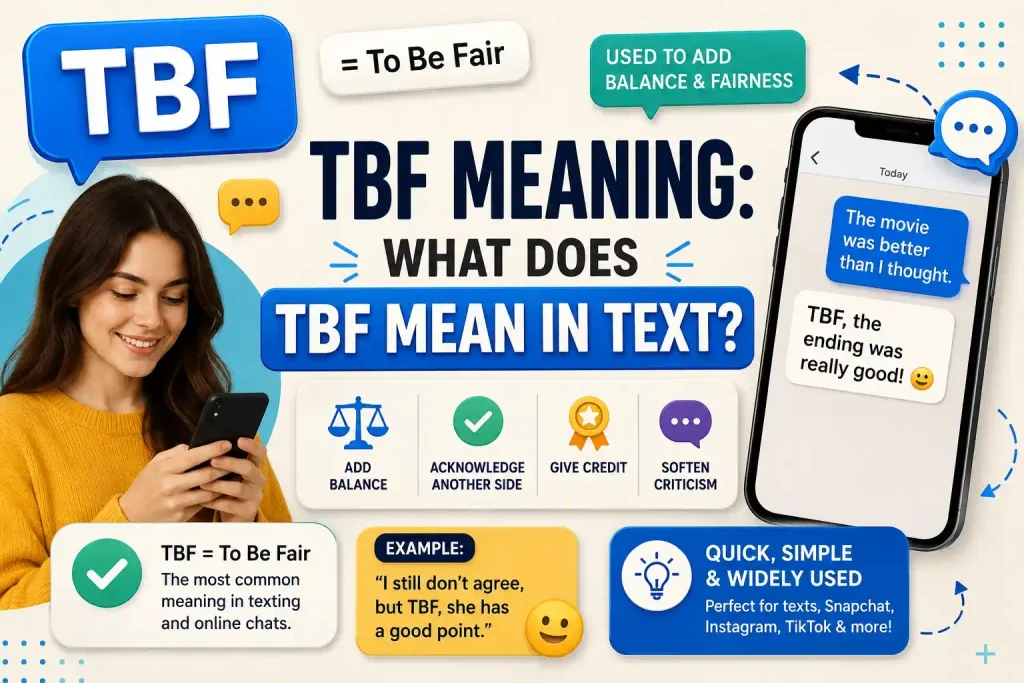
TBF most commonly means “to be fair.” People use it when they want to add a balanced point, acknowledge another side of an argument, or give someone credit before sharing their opinion. In some contexts, TBF can mean something else, but “to be fair” is the standard meaning in texting and online conversations.
I first noticed TBF in the middle of a heated group chat. Everyone was blaming one person for a problem, and then someone wrote:
“TBF, he did tell us he would be late.”
That short message changed the tone of the conversation. The person was not fully defending him. They were simply adding a fair point that others had ignored.
That is exactly how TBF usually works.
It gives you a quick way to say, “Let’s look at the other side too.”
What Does TBF Mean?
The most common TBF meaning is:
TBF = To Be Fair
People use it when they want to:
- Add balance to a discussion
- Recognize another person’s point
- Defend someone partly
- Admit that another view is reasonable
- Give credit where it is due
- Soften criticism
For example:
“TBF, the movie was better than I expected.”
This means:
“To be fair, the movie was better than I expected.”
The speaker is often changing the direction of the conversation by adding a more balanced opinion.
What Does TBF Mean in Text?
In a text message, TBF almost always means “to be fair.”
It is especially common when someone wants to acknowledge a point that might not fully match their earlier opinion.
For example:
“I still don’t like the restaurant, but TBF, the service was excellent.”
The speaker is still giving a negative opinion overall. However, they are admitting that one part was good.
This is one of the most natural ways to use TBF.
How TBF Is Used in a Conversation
TBF often appears at the beginning of a sentence, but it can also appear in the middle.
At the beginning
“TBF, she had a good reason for leaving.”
In the middle
“He was late, but, TBF, traffic was terrible.”
As a short response
A: That game was awful.
B: TBF, the ending was pretty good.
In each example, TBF introduces a fair or balancing point.
The Main Idea Behind TBF
The phrase “to be fair” has been used in English for a long time as a way to introduce fairness or balance into a statement.
The abbreviation TBF simply shortens that phrase for faster typing.
The core meaning is usually:
“Even though I think one thing, I should also recognize this other point.”
For example:
“I think he made a mistake. TBF, though, nobody explained the rules to him.”
The speaker is holding two ideas at the same time:
- He made a mistake.
- There was also a reasonable explanation.
That balance is the heart of TBF.
TBF Meaning in Different Contexts
TBF can be used in many everyday situations.
| Context | Example | Meaning |
| Texting | “TBF, you warned me.” | To be fair |
| Argument | “TBF, she has a point.” | Acknowledging another side |
| Social media | “TBF, this is actually funny.” | Giving credit |
| Review | “TBF, the quality is good.” | Balanced opinion |
| Debate | “TBF, both sides have valid points.” | Fair consideration |
The meaning remains the same, but the tone may change.
TBF Meaning on Snapchat
On Snapchat, TBF usually means “to be fair.”
For example:
“TBF, you did say you were busy 😂.”
The person is acknowledging something that is true.
Snapchat messages are often quick and informal, so abbreviations like TBF fit naturally into conversations.
TBF Meaning on Instagram
In Instagram comments and DMs, TBF also commonly means “to be fair.”
For example:
“TBF, this outfit actually looks good.”
The person may have expected the opposite but is giving honest credit.
You may also see TBF in discussions about:
- Celebrities
- Movies
- Sports
- Fashion
- Music
- Viral topics
The abbreviation often helps someone present a more balanced opinion.
TBF Meaning on TikTok
On TikTok, TBF usually means “to be fair.”
You might see a comment like:
“TBF, he did explain it in the first video.”
The commenter is adding context before people judge someone.
Another example:
“TBF, that trend is harder than it looks.”
The person is giving a fair perspective.
What Does TBF Mean From a Girl?
If a girl sends you TBF, it normally means “to be fair.”
For example:
You: I thought you forgot.
Her: TBF, I told you I was busy.
She is pointing out something that should be considered fairly.
There is no special hidden meaning based on the sender’s gender.
The surrounding conversation is much more important.
What Does TBF Mean From a Guy?
The meaning is generally the same.
For example:
You: That movie was terrible.
Him: TBF, the first half was good.
He is adding a balancing opinion.
TBF does not become romantic, rude, or gender-specific just because of who sends it.
TBF vs TBH: What Is the Difference?
TBF and TBH are often confused because both are common internet abbreviations.
However, they mean different things.
TBF = To Be Fair
TBH = To Be Honest
TBF
Use TBF when adding a fair or balanced point.
“TBF, he tried his best.”
TBH
Use TBH when giving an honest opinion.
“TBH, I didn’t enjoy the movie.”
Here is a simple comparison:
| Abbreviation | Meaning | Main Purpose |
| TBF | To Be Fair | Add balance |
| TBH | To Be Honest | Share an honest opinion |
A person can even use both in one sentence:
“TBH, I didn’t like the movie, but TBF, the acting was excellent.”
This means:
- Honestly, I did not like the movie.
- Fairly speaking, the acting was good.
TBF vs IMO
Another abbreviation often used in discussions is IMO.
IMO = In My Opinion
The difference is simple.
TBF
Focuses on fairness or balance.
“TBF, she was never given a chance to explain.”
IMO
Shows that you are sharing a personal view.
“IMO, she should have explained earlier.”
TBF considers another side.
IMO emphasizes your own opinion.
TBF vs FYI
TBF and FYI have completely different purposes.
TBF = To Be Fair
FYI = For Your Information
Example:
“TBF, he was already busy.”
This adds a balancing point.
“FYI, the meeting starts at 9.”
This provides information.
The two abbreviations may look similar, but they should not be used interchangeably.
TBF vs “However”
TBF can sometimes serve a similar purpose to words such as however, although, or to be honest.
But they are not exactly the same.
For example:
“The restaurant was expensive. TBF, the food was excellent.”
You could also say:
“The restaurant was expensive. However, the food was excellent.”
The meaning is similar, but TBF has a more conversational tone.
TBF also suggests fairness or giving credit.
That makes it useful in informal discussions.
Can TBF Be Used as an Excuse?
Sometimes people use TBF to explain or defend something.
For example:
“TBF, I never said I would come.”
The person is pointing out a fact that supports their side.
However, TBF does not automatically make an excuse valid.
It simply introduces a point that the speaker believes should be considered.
Can TBF Sound Rude?
Usually, TBF is not rude.
It often makes a statement sound more balanced.
For example:
“TBF, you were warned.”
This can be direct, but it is not automatically rude.
However, tone matters.
“TBF, that was your own fault.”
This may sound harsh.
The abbreviation itself is neutral. The rest of the message determines the tone.
Can TBF Be Sarcastic?
Yes. Like many common phrases, TBF can be used sarcastically.
For example:
“TBF, he only ignored every single message 😂.”
The speaker is not being seriously fair. They are joking about the situation.
Sarcasm is easier to understand when you look at:
- The surrounding conversation
- Emojis
- Exaggerated wording
- The relationship between the people involved
Without context, a sarcastic use of TBF can be misunderstood.
Where Did TBF Come From?
TBF comes directly from the phrase “to be fair.”
The phrase itself is standard English and has long been used in spoken and written communication to introduce balance or fairness.
As texting and online communication became faster, people began shortening common phrases into initialisms.
For example:
- TBH = To Be Honest
- IDK = I Don’t Know
- IMO = In My Opinion
- TBF = To Be Fair
There is no single person known for inventing TBF. It developed as part of broader internet and texting language.
Is TBF Used in Different Countries?
TBF is based on an English phrase, so it can be understood in many English-speaking online communities.
You may see it in:
- The United States
- The United Kingdom
- Canada
- Australia
- Pakistan
- India
- Other international online communities
The standard meaning remains “to be fair.”
However, usage can vary.
Some people use TBF regularly in messages. Others prefer writing the complete phrase.
It is more likely to appear in casual digital communication than in formal writing.
How to Use TBF Correctly
Use TBF when you want to acknowledge a fair point or add balance.
Good example
“I didn’t like the event, but TBF, the food was great.”
The sentence gives both a negative and positive view.
Another good example
“TBF, she told us she might be late.”
The speaker is reminding others to consider an important fact.
Less useful example
“TBF, I’m going to the store.”
There is no clear balancing point.
TBF works best when you are responding to an opinion, criticism, disagreement, or judgment.
Real-Life Examples of TBF
Example 1: Giving credit
A: That restaurant was terrible.
B: TBF, the dessert was amazing.
The second person is giving credit to one positive part.
Example 2: Defending someone
A: Why was he late again?
B: TBF, there was a huge accident on the road.
The speaker is providing a fair explanation.
Example 3: A social media comment
“TBF, the remake is better than I expected.”
The writer is admitting a positive surprise.
Example 4: A disagreement
A: She never helps.
B: TBF, she helped us last weekend.
The second person is correcting an unfair generalization.
Example 5: Friendly teasing
A: You always lose.
B: TBF, I only played twice 😂.
The speaker is jokingly defending themselves.
Common Mistakes People Make With TBF
Mistake 1: Confusing TBF with TBH
TBF means To Be Fair.
TBH means To Be Honest.
Correction: Use TBF for balance and TBH for honesty.
Mistake 2: Using TBF when no balancing point exists
TBF should normally introduce a fair point.
Correction: Use it when you are adding context, giving credit, or recognizing another side.
Mistake 3: Thinking TBF means “I agree”
TBF does not always mean agreement.
Correction: You can disagree with someone while still acknowledging one valid point.
For example:
“I still disagree, but TBF, you did warn me.”
Mistake 4: Using TBF in very formal writing
Not everyone understands internet abbreviations.
Correction: Write the complete phrase, “to be fair.”
Mistake 5: Assuming TBF always sounds polite
The rest of the sentence can still sound rude.
Correction: Consider the complete message.
Mistake 6: Ignoring sarcasm
TBF can be used seriously or sarcastically.
Correction: Check the tone, emojis, and surrounding discussion.
When Should You Use TBF?
TBF is useful when you want to:
- Give someone credit
- Recognize a valid point
- Add balance to a criticism
- Defend someone partly
- Explain why a situation happened
- Make your opinion sound more fair
It is especially natural in casual conversations.
For example:
“I don’t like the new design. TBF, it is easier to use.”
This is a balanced opinion.
When Should You Avoid TBF?
Avoid TBF when:
- Writing a formal report
- Sending a professional email
- Talking to someone unfamiliar with internet slang
- The sentence does not involve fairness or balance
- You want to be completely clear
In a professional message, write:
“To be fair, there were several factors involved.”
This is clearer than:
“TBF, there were several factors involved.”
Is TBF Formal or Informal?
TBF is mainly informal.
It is common in:
- Text messages
- Social media
- Online discussions
- Casual group chats
- Gaming conversations
- Informal comments
The full phrase “to be fair” can be used in both informal and formal communication.
The abbreviation itself is best reserved for casual settings.
How to Reply When Someone Says TBF
Your reply depends on whether you agree with the point.
If you agree
“That’s true.”
If you partly agree
“TBF, you have a point, but I still disagree.”
If you disagree
“I understand what you mean, but I see it differently.”
If they are joking
“Okay, that’s fair 😂.”
TBF often invites a more balanced discussion, so your reply can acknowledge the point without giving up your own opinion.
What Does TBF Mean in Different Situations?
| Situation | Example | Meaning |
| Argument | “TBF, she warned us.” | Fair point |
| Review | “TBF, the service was good.” | Giving credit |
| Text chat | “TBF, you were right.” | Acknowledging someone |
| Social media | “TBF, this is funny.” | Honest credit |
| Debate | “TBF, both sides have reasons.” | Balanced view |
| Sarcasm | “TBF, he only forgot everything 😂.” | Humorous exaggeration |
The exact tone can change, but the central idea remains fairness.
Frequently Asked Questions About TBF Meaning
What does TBF mean in text?
TBF most commonly means “to be fair.” It is used when adding a balanced point or recognizing another side of a situation.
What does TBF mean from a girl?
It generally means “to be fair.” The sender’s gender does not change the meaning.
What does TBF mean from a guy?
It also usually means “to be fair.” Context determines the tone.
What does TBF mean on Snapchat?
On Snapchat, TBF usually means “to be fair.”
What does TBF mean on Instagram?
In Instagram comments and messages, TBF generally means “to be fair.”
What does TBF mean on TikTok?
On TikTok, TBF commonly means “to be fair.” People often use it to add context or acknowledge another point of view.
What is the difference between TBF and TBH?
TBF means “to be fair” and adds balance. TBH means “to be honest” and introduces an honest opinion.
Is TBF rude?
No. TBF is usually not rude. However, the sentence around it can sound harsh depending on the wording.
Can TBF be sarcastic?
Yes. TBF can be used sarcastically, especially in humorous online conversations.
Is TBF formal?
The abbreviation is informal. The full phrase “to be fair” can be used in formal and informal communication.
Can I use TBF in a business email?
It is better to write the full phrase, “to be fair,” in a professional email.
Final Thoughts on TBF Meaning
The most common TBF meaning is “to be fair.”
It is a useful abbreviation for adding balance, giving someone credit, or recognizing a point that deserves consideration.
You can use it when you want to say:
“I may not fully agree, but this part is fair.”
That is why TBF appears so often in texting, social media, group chats, and online discussions.
The next time someone writes:
“TBF, you did warn me,”
you will know they are acknowledging that you had a fair point.
And when you want to use it yourself, remember the simple rule:
Use TBF when you are adding fairness or balance to the conversation.


