
IDM Meaning in Text: What Does IDM Mean?
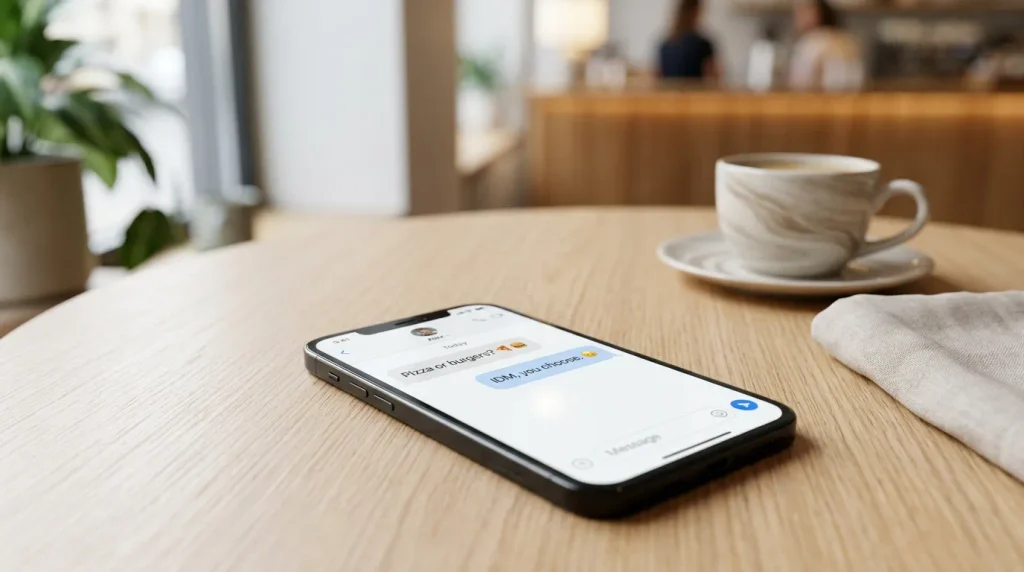
IDM in text most commonly means “I Don’t Mind.” People use it to show that they are okay with something, have no strong preference, or are happy for another person to choose.
I first saw IDM in a message like this:
“Do you want pizza or burgers?”
“IDM, you choose.”
For a second, the reply looked confusing. Was it a typo? A new slang word? Or an abbreviation with a hidden meaning?
The answer was simple. The person meant “I don’t mind.”
That is the most common IDM meaning in text, but the abbreviation can have different meanings in other situations. The context is what tells you which meaning is intended.
What Does IDM Mean in Text?
In most text messages, IDM means “I Don’t Mind.”
People use it when they do not have a strong preference or when they are comfortable with either option.
For example:
Person 1: Do you want to watch a movie or a series?
Person 2: IDM, you choose.
The second person means:
“I don’t mind. You can choose.”
It is a quick and casual way to show flexibility.
The Most Common IDM Meaning
The main meaning is:
IDM = I Don’t Mind
Here is how it usually works:
| Abbreviation | Full Meaning | Typical Use |
| IDM | I Don’t Mind | No strong preference |
| IDM | Other context-specific meanings | Technical or specialized discussions |
In everyday texting, chatting, and social media, “I Don’t Mind” is usually the meaning people are looking for.
How Is IDM Used in Text Messages?
IDM is often used when someone gives you a choice.
For example:
“Should we go out tonight?”
“IDM.”
This means:
“I don’t mind.”
The person is saying they are okay with either choice.
You may also see it in longer messages.
Example 1
“IDM where we eat. You choose.”
Example 2
“IDM if we leave early.”
Example 3
“Honestly, IDM. Both options are fine.”
Example 4
“You can come tomorrow instead. IDM.”
In all of these examples, IDM shows that the person has no serious objection.
What Does IDM Mean From a Girl?
If a girl sends IDM in a normal conversation, it usually means “I Don’t Mind.”
For example:
You: Should we talk later tonight?
Her: IDM.
The meaning is generally simple:
“I’m okay with that.”
However, the tone depends on the conversation.
“IDM” may sound:
- Relaxed
- Friendly
- Neutral
- Indifferent
If you want to understand the exact tone, look at the full conversation instead of focusing on the abbreviation alone.
For example:
“IDM 😊” may sound warm and friendly.
“IDM.” may sound more neutral.
What Does IDM Mean From a Guy?
The meaning is usually the same.
If a guy sends IDM, he most likely means “I Don’t Mind.”
For example:
You: Do you want to meet on Saturday or Sunday?
Him: IDM, either is fine.
He is saying that he does not have a preference.
The sender’s gender does not change the standard meaning of IDM. Context matters much more.
IDM Meaning on Snapchat
On Snapchat, IDM usually means “I Don’t Mind.”
You may see it in conversations about:
- Meeting plans
- Video calls
- Photos
- Games
- Timing
- Places to go
For example:
“Do you want to keep the streak going?”
“IDM.”
The person means they are okay with it.
Snapchat conversations often use short forms because messages are quick and informal. IDM fits naturally into that style.
IDM Meaning on Instagram
In Instagram DMs, IDM also commonly means “I Don’t Mind.”
For example:
“Can I tag you in this post?”
“IDM.”
That means:
“I don’t mind. That is okay.”
The abbreviation is common in casual online conversations where people want to type quickly.
IDM Meaning on TikTok
The meaning of IDM on TikTok can depend on the content.
In private messages and casual comments, it often means:
“I Don’t Mind.”
For example:
“IDM if you post part two.”
The person means they are okay with it.
However, TikTok also has different communities with their own slang. If IDM appears in a discussion about music, technology, or another specialized topic, it may mean something different.
Always consider the topic before deciding.
IDM Meaning in Different Contexts
The same abbreviation can have different meanings depending on where you see it.
| Context | Most Likely Meaning |
| Casual text message | I Don’t Mind |
| Snapchat chat | I Don’t Mind |
| Instagram DM | I Don’t Mind |
| Group chat | I Don’t Mind |
| Dating conversation | I Don’t Mind |
| Technical discussion | May have another meaning |
| Music discussion | May refer to a specific term or genre |
In normal texting, I Don’t Mind is usually the safest interpretation.
Is IDM the Same as IDK?
No. These two abbreviations look similar, but they have different meanings.
IDM = I Don’t Mind
IDK = I Don’t Know
Here is the difference:
IDM
“Do you want tea or coffee?”
“IDM.”
Meaning:
“I don’t mind. Either is okay.”
IDK
“What time does the movie start?”
“IDK.”
Meaning:
“I don’t know.”
This is a common mistake because both abbreviations start with the letters “ID.”
IDM vs IDK vs IDC
These abbreviations can express different attitudes.
| Abbreviation | Meaning | What It Shows |
| IDM | I Don’t Mind | No strong preference |
| IDK | I Don’t Know | Lack of information |
| IDC | I Don’t Care | Lack of interest or concern |
The differences matter.
IDM sounds flexible
“IDM where we go.”
You are okay with any reasonable option.
IDK shows uncertainty
“IDK where we should go.”
You do not know which option to choose.
IDC can sound stronger
“IDC where we go.”
This may mean you have no preference, but it can also sound dismissive depending on the tone.
For this reason, IDM is often a softer and more polite choice than IDC.
IDM vs IDC: What Is the Real Difference?
This is one of the most useful distinctions to understand.
IDM means you are okay with the options
“IDM what we watch.”
This usually means:
“I am happy with whatever we watch.”
IDC can mean you do not care
“IDC what we watch.”
This may mean the same thing in a casual setting, but it can sound colder.
For example:
“IDM, you can choose 😊.”
sounds cooperative.
“IDC.”
may sound like the person is uninterested in the conversation.
So, if you want to sound polite and flexible, IDM is usually the better abbreviation.
When Should You Use IDM?
Use IDM when you genuinely have no strong preference.
It works well when:
- Someone asks you to choose between options
- You are okay with another person’s plan
- You want to show flexibility
- You want the other person to decide
- You agree with more than one option
For example:
“Should I call you now or later?”
“IDM, whenever you’re free.”
That is a natural use of the abbreviation.
Real-Life Examples of IDM in Text
Example 1: Choosing food
A: Pizza or burgers?
B: IDM, both sound good.
Meaning: I don’t mind.
Example 2: Making plans
A: Should we meet at 6 or 7?
B: IDM. You choose.
Meaning: Either time is fine.
Example 3: Watching something
A: Do you want to watch a comedy?
B: IDM, as long as it’s good.
Meaning: I do not have a strong preference.
Example 4: Changing plans
A: Is it okay if we go tomorrow instead?
B: Yeah, IDM.
Meaning: I am okay with that.
Example 5: A casual group chat
A: Should we order now?
B: IDM, wait for the others if you want.
Meaning: Either choice is acceptable.
Can IDM Mean You Are Not Interested?
Sometimes, but not always.
The basic meaning of IDM is “I Don’t Mind.”
However, a very short reply can sometimes sound like the person has little interest in making the decision.
For example:
“What do you want to do?”
“IDM.”
The person may simply be relaxed. But they may also be leaving all the planning to you.
This is why tone matters.
Compare:
“IDM! I’m happy with anything 😊”
This sounds positive.
“IDM.”
This sounds more neutral.
The abbreviation itself is not negative. The conversation around it creates the tone.
Is IDM Rude?
No. IDM is not rude by itself.
It usually sounds casual and flexible.
However, it can feel unhelpful if someone is asking for your genuine opinion and you keep replying with IDM.
For example:
“Where do you want to go?”
“IDM.”
“What do you want to eat?”
“IDM.”
“What movie do you want?”
“IDM.”
After several replies, the other person may feel that you are not helping with the decision.
A better response could be:
“IDM, but I’d prefer somewhere close.”
This gives the other person useful information while still showing flexibility.
How to Use IDM Politely
IDM works best when you add a little context.
Instead of writing only:
“IDM.”
You can say:
- “IDM, you can choose.”
- “IDM, either one is fine.”
- “IDM, whatever works for you.”
- “I don’t mind. What do you prefer?”
- “IDM, but I’d rather go later.”
These replies feel clearer and more natural.
Can You Use IDM in Formal Writing?
Generally, no.
IDM is informal internet and texting language.
It is suitable for:
- Text messages
- Social media
- Casual chats
- Friends
- Family
- Informal group messages
It is usually not suitable for:
- Business emails
- Academic writing
- Official documents
- Formal workplace communication
Instead of writing:
“IDM if the meeting is moved.”
You could write:
“I do not mind if the meeting is moved.”
Or:
“I am comfortable with moving the meeting.”
The full version is clearer in professional settings.
Where Did IDM Come From?
IDM developed from the broader practice of shortening common phrases in digital communication.
As texting, chat rooms, instant messaging, and social media became more common, people began using initials to save time and space.
Instead of typing:
“I don’t mind.”
A person could write:
“IDM.”
Like many common internet abbreviations, its use spread through informal online communication rather than being created by one clearly identified person.
Is IDM Used in Different Countries?
IDM is based on an English phrase, so it can appear anywhere people use English online.
You may see it in conversations in:
- The United States
- The United Kingdom
- Canada
- Australia
- Pakistan
- India
- Other English-speaking or multilingual online communities
Its popularity may vary by country, age group, and friend circle.
Some people use abbreviations frequently. Others prefer writing the complete phrase.
There is no major difference in the standard meaning. IDM still generally means “I Don’t Mind.”
Common Mistakes People Make With IDM
Mistake 1: Confusing IDM with IDK
IDM means I Don’t Mind.
IDK means I Don’t Know.
Correction: Remember that the last letter changes the meaning.
Mistake 2: Thinking IDM means the same as IDC
They can sometimes be used in similar situations, but their tone can differ.
Correction: Use IDM when you want to sound flexible. Be careful with IDC because it may sound dismissive.
Mistake 3: Assuming IDM always means the same thing
Outside texting, IDM may have other meanings.
Correction: Check the topic and context.
Mistake 4: Using IDM in formal communication
Not everyone understands internet abbreviations.
Correction: Write “I don’t mind” or use a clearer professional phrase.
Mistake 5: Using IDM when you actually have a preference
If you strongly want one option, saying IDM can create confusion.
Correction: Share your preference clearly.
For example:
“I’d prefer Friday, but IDM if Saturday works better.”
Mistake 6: Giving only “IDM” when someone needs help deciding
The other person may feel you are leaving all the work to them.
Correction: Add your thoughts when possible.
What Should You Reply When Someone Says IDM?
Your reply depends on the conversation.
If they are giving you the choice, you can simply choose an option.
For example:
A: IDM, you choose.
B: Okay, let’s get pizza.
You can also ask again if you genuinely want their opinion.
“Are you sure? Which one would you prefer?”
Or you can keep the conversation casual:
“Okay, then I’m choosing for both of us 😂.”
Is IDM Common Slang?
IDM is a recognized texting abbreviation, but it is not necessarily as widely used as terms such as:
- LOL
- OMG
- IDK
- BRB
- TTYL
Some people may understand it immediately, while others may not.
If you think the person may not know the abbreviation, it is better to write the full phrase:
“I don’t mind.”
Clear communication is usually more important than using short forms.
How to Know What IDM Means in a Message
Use these simple steps.
Step 1: Read the full conversation
Do not look at IDM alone.
Step 2: Check the topic
If people are discussing options or plans, IDM probably means I Don’t Mind.
Step 3: Look at the sentence
For example:
“IDM where we go.”
The meaning is clear.
Step 4: Consider the platform
In casual messages, the standard texting meaning is more likely.
Step 5: Ask if necessary
If the context is unusual, you can simply ask:
“What do you mean by IDM?”
There is nothing wrong with asking for clarification.
IDM Meaning in Different Situations
| Situation | Example | Meaning |
| Choosing food | “IDM, you pick.” | No preference |
| Making plans | “IDM what time.” | Any reasonable time is okay |
| Changing plans | “Yeah, IDM.” | I am okay with the change |
| Social media chat | “IDM if you post it.” | I have no objection |
| Group decision | “IDM, whatever everyone wants.” | I will go along with the group |
In most everyday examples, IDM communicates flexibility.
Frequently Asked Questions About IDM Meaning in Text
What does IDM mean in text?
IDM most commonly means “I Don’t Mind.” It shows that someone has no strong preference or is okay with an option.
What does IDM mean from a girl?
Usually, it means “I Don’t Mind.” The meaning does not change based on the sender’s gender. The full conversation helps you understand the tone.
What does IDM mean from a guy?
It generally means “I Don’t Mind.” The person is usually saying that they are okay with the available options.
What does IDM mean on Snapchat?
On Snapchat, IDM commonly means “I Don’t Mind.”
What does IDM mean on Instagram?
In Instagram messages, IDM usually means “I Don’t Mind.”
Is IDM the same as IDK?
No. IDM means “I Don’t Mind,” while IDK means “I Don’t Know.”
What is the difference between IDM and IDC?
IDM means you have no strong preference. IDC means “I Don’t Care” and may sound more dismissive depending on the context.
Is IDM rude?
No. IDM is usually not rude. However, a short reply without context can sometimes sound indifferent.
Can IDM be used in formal writing?
It is better to avoid IDM in formal writing. Write the complete phrase instead.
What does “IDM, you choose” mean?
It means:
“I don’t mind. You can make the decision.”
How should I reply to IDM?
If the person is giving you the choice, you can choose an option or ask for their preference.
Final Thoughts on IDM Meaning in Text
The most common IDM meaning in text is “I Don’t Mind.”
People use it when they are okay with different options, do not have a strong preference, or are happy to let someone else decide.
The abbreviation is simple, but the tone can change depending on the conversation.
“IDM 😊” can sound friendly and relaxed.
“IDM.” can sound neutral.
If you are ever unsure, read the messages around it. In casual conversations about choices, plans, or preferences, IDM almost always means:
“I Don’t Mind.”
Once you understand the context, this small texting abbreviation is easy to recognize and use correctly.


