
Why Every Vehicle Owner Should Consider a GPS Tracker in 2026
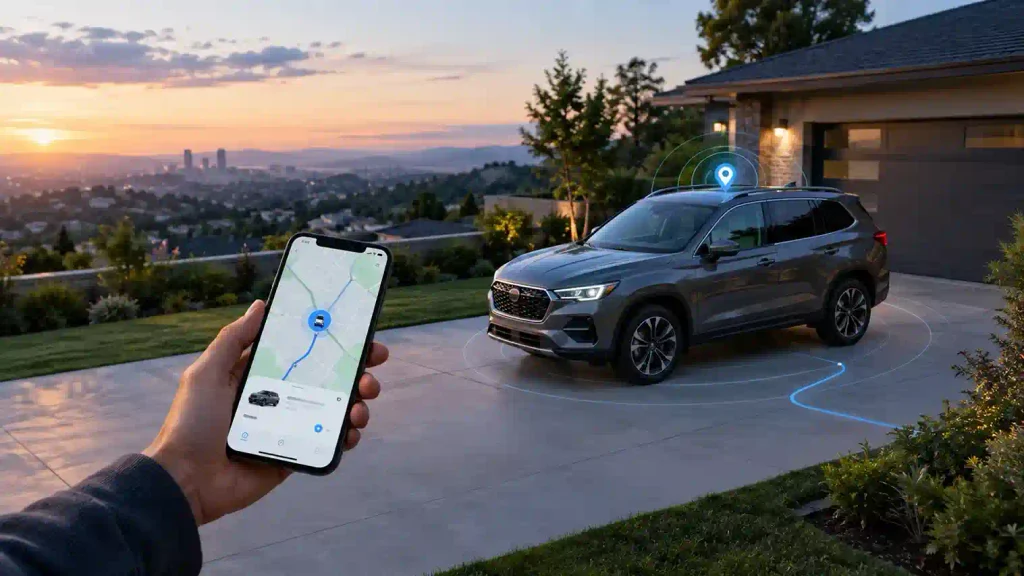
Cars get stolen. Teens borrow the family SUV and take detours nobody agreed to. Delivery vans drift off their routes. And somewhere in the back of every vehicle owner’s mind is the same quiet worry: where is my vehicle right now, and is it safe?
That worry used to be something you just lived with. Not anymore. GPS trackers have gone from a niche tool for fleet managers to an everyday accessory for regular drivers, parents, small business owners, and anyone who simply wants a little more certainty about where their vehicle is at all times.
If you have been on the fence about installing one, here is a clear look at why 2026 might be the year you finally do.
What a GPS Tracker Actually Does
At its core, a GPS tracker does one job: it tells you where your vehicle is, at all times, without you having to be there to see it. It does this by combining two technologies. A GPS chip inside the device communicates with satellites to calculate exact coordinates, and a built-in cellular connection sends those coordinates to a server in real time. That combination is what lets you check a vehicle’s location from your phone, whether it is parked in your driveway or three states away.
Beyond simply showing a dot on a map, most trackers are constantly logging data in the background, so the device is not just answering “where is it now,” but also “where has it been, how fast was it moving, and did anything unusual happen along the way.”
How It Gets Installed
The way a tracker does its job depends partly on how it is fitted to the vehicle:
- Plug-in (OBD-II): Connects to the OBD-II port under the dashboard. No tools needed, and it can be moved between vehicles in minutes.
- Hardwired: Wired directly into the electrical system, usually hidden behind the dashboard or under a seat. Harder to spot or remove, and it does not depend on a battery.
- Battery-powered: Self-contained, for trailers, boats, equipment, or vehicles without accessible power. A magnetic mini GPS tracker like this can run independently for weeks or months per charge.
- Magnetic: Attaches externally, often in a wheel well or on the undercarriage. Best for short-term or temporary tracking needs.
What You Can Actually Do With It
Once installed, the tracker feeds its data into a mobile app or web dashboard, where the real functionality shows up:
- View live location updates, as frequently as every few seconds depending on the device
- Pull up full trip history, including routes, stops, and time spent at each location
- Monitor real-time speed and get alerted if it crosses a set limit
- Set geofences that trigger an alert the moment the vehicle enters or leaves a defined area
- Get instant notifications for unauthorized movement, power disconnection, or low battery
So the device itself handles the tracking and reporting; the app is where that raw location data turns into something an owner can actually act on.
Why More Vehicle Owners Are Switching to GPS Trackers in 2026
GPS trackers used to be something only delivery companies and fleet managers bothered with. That has changed. More everyday drivers, parents, and small business owners are installing them for reasons that go far beyond just “knowing where the car is,” from faster theft recovery to real peace of mind on the road.
1. Theft Recovery Happens Faster
Vehicle theft remains a real concern in many parts of the world, and recovery odds drop fast once a car is out of sight. A GPS tracker changes that equation. Instead of waiting on a police report and hoping for the best, owners with a tracker installed can:
- See the vehicle’s live location the moment it moves without authorization
- Share that location directly with law enforcement
- Set up geofencing alerts that notify them the second the car leaves a designated area
Vehicles fitted with a tracker are recovered significantly faster than those without one, simply because the search starts with a known location instead of a blank map.
2. Peace of Mind for Parents of New Drivers
Handing a teenager the car keys is one of the more nerve-wracking parenting milestones. A GPS tracker will not stop a teen from making mistakes, but it does give parents visibility they did not have before, including:
- Real-time location during drives
- Speed alerts if the car exceeds a set limit
- Notifications when the vehicle arrives at or leaves school, home, or a curfew boundary
This is not about spying. It is about having a safety net in place while a new driver builds experience and being able to respond quickly if something goes wrong.
3. Better Oversight for Small Business Fleets
If your vehicles are also your business, tracking is no longer optional; it is operational common sense. Small business owners running delivery vehicles, service vans, or work trucks use GPS trackers to:
- Confirm routes are being followed efficiently
- Reduce fuel costs by cutting down on unnecessary idling and detours
- Provide accurate arrival estimates to customers
- Maintain a location record in case of disputes or accidents
Even a two- or three-vehicle operation can see a noticeable return simply from route efficiency and reduced downtime.
4. Protection for Trailers, Boats, and Equipment
Vehicle owners often forget that theft risk is not limited to the car itself. Trailers, boats, ATVs, and heavy equipment are frequently targeted because they are easier to disconnect and disappear with. A battery-powered GPS tracker designed for this kind of asset can run independently for weeks or months, sending alerts if the trailer moves without authorization, even if it is sitting unattended in a storage lot overnight.
5. Support During Insurance Claims and Disputes
After an accident, insurance claims can turn into a back-and-forth over who was where and when. GPS tracker data provides a timestamped, objective record of a vehicle’s location and movement, which can:
- Speed up claims processing
- Support your account of events with actual data
- In some cases, qualify the vehicle for insurance discounts, since insurers view tracked vehicles as lower risk
Real-Life Scenarios: When a GPS Tracker Pays for Itself
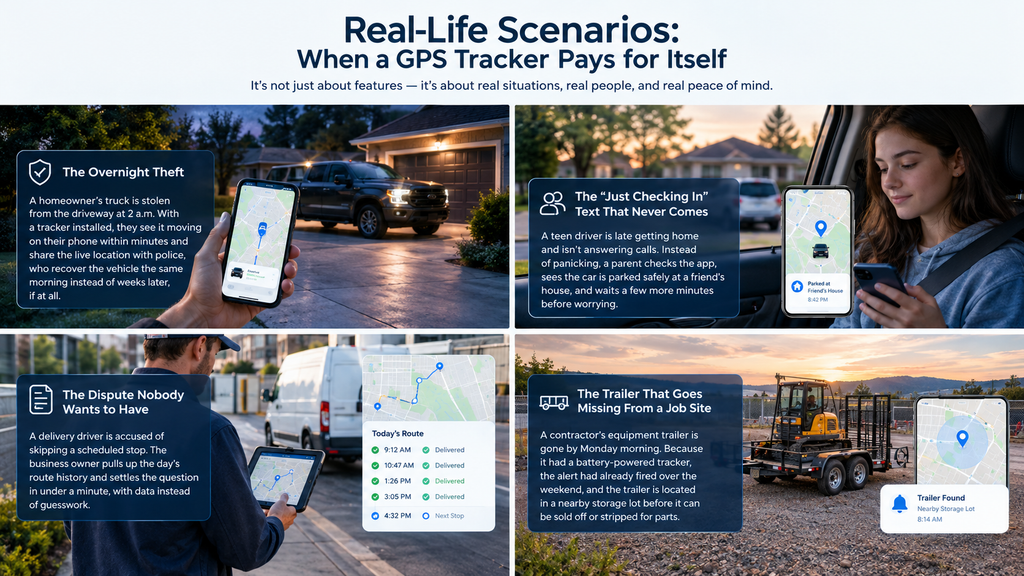
Sometimes the value of a GPS tracker is easier to see through situations rather than specs. A few common ones:
- The overnight theft: A homeowner’s truck is stolen from the driveway at 2 a.m. With a tracker installed, they see it moving on their phone within minutes and share the live location with police, who recover the vehicle the same morning instead of weeks later, if at all.
- The “just checking in” text that never comes: A teen driver is late getting home and isn’t answering calls. Instead of panicking, a parent checks the app, sees the car is parked safely at a friend’s house, and waits a few more minutes before worrying.
- The dispute nobody wants to have: A delivery driver is accused of skipping a scheduled stop. The business owner pulls up the day’s route history and settles the question in under a minute, with data instead of guesswork.
- The trailer that goes missing from a job site: A contractor’s equipment trailer is gone by Monday morning. Because it had a battery-powered tracker, the alert had already fired over the weekend, and the trailer is located in a nearby storage lot before it can be sold off or stripped for parts.
None of these situations are rare. They are the everyday reasons GPS trackers have shifted from “nice to have” to something more owners simply expect their vehicle to have.
What to Look for Before You Buy
Not all GPS trackers are built the same, and the right one depends on what you are trying to protect. Before choosing a device, it helps to think through a few basics.
Installation Type
Decide whether you want a plug-and-play device you can set up yourself in minutes, or a hardwired unit that is more discreet but usually requires professional installation.
Update Frequency
Some trackers update location every few seconds; others check in every few minutes. For theft recovery, faster updates matter. For general fleet or trailer monitoring, less frequent updates are usually fine and can extend battery life.
Battery Life
If the device is for a personal vehicle that runs regularly, power draw is less of a concern. For trailers, storage vehicles, or equipment that sits idle, look for trackers with long standby battery life, ideally measured in months rather than days.
Alerts and Geofencing
Look for a tracker that lets you set custom boundaries and receive instant notifications when a vehicle enters or leaves that zone. This feature alone covers a large share of what most owners actually want: knowing the moment something is off.
App Usability
A tracker is only as useful as the app connected to it. Before buying, check that the app is simple to navigate, works reliably on both iOS and Android, and does not bury basic features behind confusing menus.
Subscription Costs
Most GPS trackers require an ongoing data plan to stay connected. Factor this monthly or annual cost into your decision, since it is often a bigger long-term expense than the device itself. Providers like SpaceHawk GPS are worth comparing for USA-based support and no-contract plans.
Conclusion
A GPS tracker will not prevent every problem a vehicle owner might face, but it closes a gap that used to be impossible to close: not knowing. Whether the goal is recovering a stolen car faster, keeping tabs on a new teen driver, running a small fleet more efficiently, or simply having documented proof of where a vehicle was at a given time, the value of that visibility keeps growing as the technology gets smaller, smarter, and more affordable.
Heading into 2026, GPS trackers are no longer a specialty tool reserved for logistics companies. They have become a practical, low-cost way for everyday vehicle owners to protect what they have worked hard for. If you have been putting off the decision, this is a good year to stop waiting and start tracking.
FAQ
Is it legal to install a GPS tracker on my own vehicle?
Yes. Tracking a vehicle you own is legal in virtually all jurisdictions. Laws generally only restrict tracking a vehicle you do not own or have permission to monitor, so this mainly applies to fleet and shared vehicle situations, not personal cars.
Will a GPS tracker drain my car battery?
Most modern trackers, especially OBD-II and hardwired models, draw very little power and are designed not to meaningfully affect a healthy car battery. Battery-powered trackers for trailers and equipment run independently and do not touch the vehicle’s electrical system at all.
Can a thief find and remove the tracker?
A visible or easily accessible tracker can be found and removed. This is why many owners choose a hardwired or well-hidden installation, particularly for theft-recovery purposes, rather than a magnetic unit stuck somewhere obvious.
Do I need a professional to install one?
It depends on the device. Plug-in OBD-II trackers and magnetic units are designed for self-installation. Hardwired trackers, which offer more discreet placement and tamper resistance, are usually best left to a professional installer.
Does a GPS tracker work outside cell coverage or across state lines?
Yes. State lines aren’t an issue since trackers run on nationwide cellular networks. In areas with no signal, the device keeps recording location data and syncs it once it reconnects.