
Manufacturing 4.0: Why Type 4 PoE Is Ideal for Industrial IoT
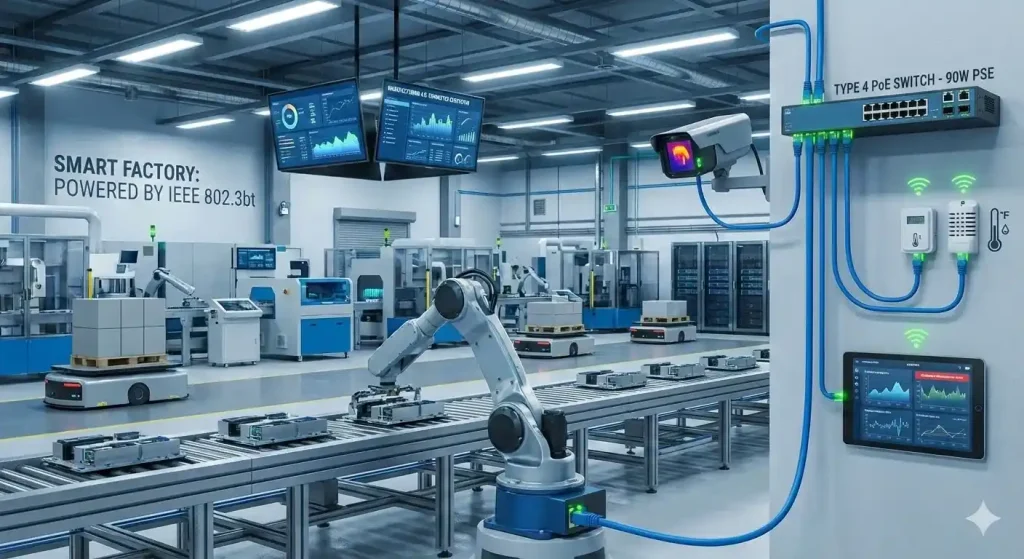
Manufacturing 4.0: Why Type 4 PoE Is Ideal for Industrial IoT
Known as the Fourth Industrial Revolution, Industry 4.0 refers to the ongoing, transformative phase where smart factories leverage interconnected devices for automation, real-time analytics, and predictive maintenance. Also called Manufacturing 4.0, it bridges the gap between the physical and digital worlds, creating a truly connected production ecosystem
Industrial IoT (IIoT) is the foundation of the smart factory that enables Manufacturing 4.0. Networks of sensors, instruments, and systems that support intelligent manufacturing work together to improve operational efficiency, productivity, and safety by creating a highly connected, data-driven, industrial ecosystem. However, deploying IIoT in harsh manufacturing environments introduces challenges such as complex wiring, power reliability, and scalability.
Combining power and data delivery, Type 4 PoE (IEEE 802.3bt) is a game-changer for IIoT in manufacturing. As the latest Power over Ethernet (PoE) standard, it delivers up to 90W to power source equipment (PSE) and up to 71W to powered devices (PDs) over all four twisted pairs of copper wire inside Cat 5e or better Ethernet cables.
Empowering industrial facilities to achieve seamless IIoT integration, Type 4 PoE offers simplified infrastructure, cost efficiency, and enhanced reliability.
Understanding Type 4 PoE
Power over Ethernet (PoE) is the technology that delivers both power and data over a single Ethernet cable, eliminating the need for separate electrical wires.
The evolution of PoE standards includes:
- Type 1 PoE (IEEE 802.3af): up to 15.4W of power
- Type 2 PoE+ (IEEE 802.3at): up to 30W of power
- Type 3 PoE++ (IEEE 802.3bt): up to 60W of power
- Type 4 PoE++ (IEEE 802.3bt): up to 90W of power
Type 4 PoE uses all four twisted wire pairs within the cable for maximum power delivery and automatic power negotiation between PSE and PDs. Type 4 PoE supports the high-power needs of IIoT devices in rugged environments, aligning the goals of industrial automation, edge computing, and AI integration. High-wattage capability aligns with the increasing demands of automation and AI integration in rugged industrial environments, future-proofing network infrastructure.
Why is Type 4 PoE ideal for IIoT?
Type 4 PoE is well-suited for IIoT applications, primarily because it can power high-demand industrial devices in complex, harsh environments.
Simplified Installation and Cost Savings
Type 4 PoE eliminates the need for separate power cables, outlets, and conduits, reducing infrastructure complexity by up to 50%. In large manufacturing facilities, this lowers installation and maintenance costs.
Support for Higher Power Devices
Type 4 PoE powers demanding IIoT applications such as AI-enabled cameras, robotics, and LiDAR sensors. Earlier versions of PoE can’t handle these efficiently.
Scalability and Flexibility
Adding or relocating IIoT devices is easy with Type 4 PoE. Dynamic manufacturing layouts are supported without rewiring.
Enhanced Safety and Reliability
Operating at low voltage (48-55V DC), Type 4 PoE minimizes electrical hazards in industrial settings. Features like redundant power supplies, overload protection, and Perpetual PoE, which supports uninterrupted power during reboots, reduce downtime.
Energy Efficiency and Centralized Management
Sustainability is a growing priority in Manufacturing 4.0. Type 4 PoE supports centralized power management, enabling monitoring, power prioritization, and automatic shut-off for non-essential devices via tools like PoE analytic dashboards.
As an Active PoE standard, Type 4 PoE supports intelligent power negotiation. Power sourcing equipment performs a “handshake” with PDs to supply the exact amount of power needed. This enables power budget management and prevents damage to the device.
Key PoE Applications in Manufacturing Environments
Leveraging a single Ethernet cable for both data transmission and electrical power, Type 4 PoE applications enable the smart factory vision of IIoT in manufacturing environments.
- Surveillance and Security – Supports high-definition PTZ cameras and access controls in factories.
- Automation and Robotics – Powers robotic arms, conveyor systems, and control systems for real-time automation.
- Wireless Connectivity – Enables Wi-Fi 6/6e access points for seamless data exchange.
- Edge Computing and AI Integration – Delivers power to edge devices for on-site processing.
- Environmental Monitoring – Powers sensors for temperature, vibration, humidity, and energy usage.
Type 4 PoE supports Manufacturing 4.0’s focus on real-time decision-making and reduced latency, while enhancing smart logistics and facilitating data-driven insights for quality assurance and efficiency in harsh industrial settings.
Implementing Type 4 PoE in Manufacturing
Deploying PoE in manufacturing involves careful planning around infrastructure upgrades, thermal management, and system reliability. Key steps include:
- Evaluate existing infrastructure. Review cabling, power budgets, and compatibility with ruggedized PoE switches.
- Use high-performance cabling. To minimize power loss and heat, a Cat 6A or better Ethernet cable is strongly recommended. Ensure that switches have a total power budget sufficient to reliably supply all connected devices simultaneously.
- Manage heat dissipation in high-power setups, distance limitations, and integration with legacy or new building management systems. Consider limiting cable bundle size to improve airflow and prevent excessive heat rise.
- Extend network reach: Use PoE extenders and injectors to help increase the distance between PSE and PDs. PoE Boost assists with low-voltage inputs.
- Choose industrial-grade PoE switches and devices with robust metal casings, wide operating temperature ranges (-40ºC to 75ºC or higher), and fanless designs to ensure reliable operation in dusty, hot, or vibrating environments.
PoE implementation is a strategic investment that enables a more agile, resilient, and data-rich factory floor. The return on investment (ROI) is driven by reduced downtime, lower cabling costs, and energy optimization. In manufacturing, the true value of Type 4 PoE installation arises from combining savings with long-term benefits of centralized power reliability and the predictive maintenance that modern PoE devices allow.
Upgrade to Type 4 PoE with PlanetechUSA
Providing high-power, reliability, and efficient connectivity for smart industrial operations, Type 4 PoE addresses the key IIoT challenges in Manufacturing 4.0. Emerging trends such as sustainable manufacturing and AI-driven factories will further amplify the role of advanced PoE technologies in the future. A best practice for facility managers and manufacturers wanting to take full advantage of all PoE has to offer is to assess your IIoT infrastructure. Adopting Type 4 PoE with the help of Planet Technology USA can help bring competitive advantages in digital transformation.