
Queen Charlotte Ethnicity: German Royal Roots and the African Ancestry Debate
Table of Contents
- Quick Facts About Queen Charlotte
- What Is Queen Charlotte’s Ethnicity?
- Queen Charlotte’s Father’s Ethnicity
- Queen Charlotte’s Mother’s Ethnicity
- Is Queen Charlotte Black?
- Was Queen Charlotte German?
- What Was Queen Charlotte’s Nationality?
- Is Queen Charlotte Related to Queen Elizabeth II?
- Frequently Asked Questions
- Conclusion
Quick Facts About Queen Charlotte
| Attribute | Details |
|---|---|
| Full Name | Sophia Charlotte of Mecklenburg-Strelitz |
| Date of Birth | 19 May 1744 |
| Birthplace | Unteres Schloss, Mirow, Duchy of Mecklenburg-Strelitz (now northern Germany) |
| Nationality | German-born; Queen consort of Great Britain and Ireland (1761–1818), later the United Kingdom |
| Ethnicity | German; debated distant Moorish/African ancestry through the medieval Portuguese royal line (unproven) |
| Parents | Duke Charles Louis Frederick of Mecklenburg (father); Princess Elisabeth Albertine of Saxe-Hildburghausen (mother) |
| Profession | Queen consort of King George III; patron of the arts and botany |
What Is Queen Charlotte’s Ethnicity?
Queen Charlotte, born Sophia Charlotte of Mecklenburg-Strelitz, was ethnically German. She was born on 19 May 1744 in Mirow, in the small north-German duchy of Mecklenburg-Strelitz, then part of the Holy Roman Empire. Both of her parents came from German ruling families: her father, Duke Charles Louis Frederick of Mecklenburg (known as the Prince of Mirow), and her mother, Princess Elisabeth Albertine of Saxe-Hildburghausen. She married King George III of Great Britain on 8 September 1761 at the Chapel Royal in St James’s Palace, London, and served as queen consort for 57 years — the longest-serving queen consort in British history.
Over the past few decades, however, a lively debate has grown around whether Queen Charlotte also had African ancestry. The theory, popularized by historian Mario de Valdes y Cocom, traces her lineage through six different lines back to Margarita de Castro y Sousa, a 15th-century Portuguese noblewoman whose ancestry is traced further to Afonso III of Portugal and his mistress Madragana (also called Ourana), described as a Moor of Black African ancestry in the 13th century. Supporters of the theory point to Charlotte’s portraits, which they say show facial features of African origin, while critics note that the genealogical link is separated by centuries and that the racial identity of Madragana cannot be established with confidence. Mainstream historians generally describe the African-ancestry claim as intriguing but unproven, and her documented family background remains thoroughly German.
The question gained fresh attention when the Netflix series Bridgerton and its prequel Queen Charlotte: A Bridgerton Story portrayed the queen as a woman of mixed race, sparking renewed public interest in her true ethnic background.
Queen Charlotte’s Father’s Ethnicity
Queen Charlotte’s father was Duke Charles Louis Frederick of Mecklenburg (1708–1752), known as the Prince of Mirow. He was the second son of the ruling Duke of Mecklenburg-Strelitz, and although he did not inherit the main ducal throne himself, his family was part of the German aristocracy of the Holy Roman Empire. Charlotte was the youngest of his ten children. Her father died in 1752, when Charlotte was only eight years old, and it was her brother Adolphus Frederick who later succeeded to the ducal throne, bringing young Charlotte closer to court life in Neustrelitz.
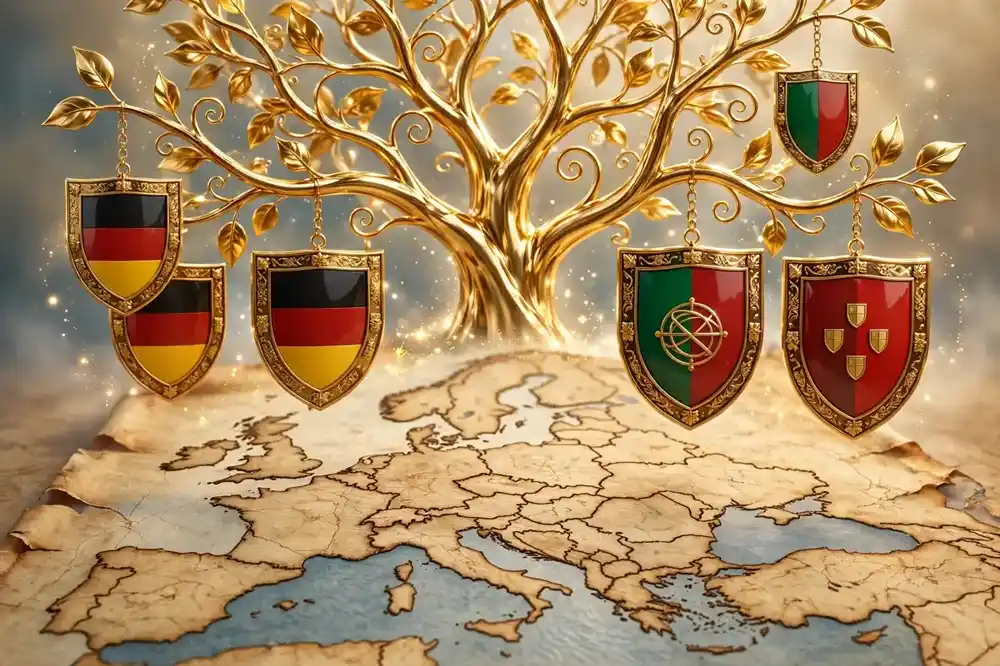
The Mecklenburg line itself descends from medieval German and Slavic nobility of the Baltic region, and genealogists have traced its intermarriages with other European royal houses, including the Portuguese royal house — the connection through which the debated African ancestry claim is routed. Like Meghan Markle, whose mixed-race heritage made headlines when she married into the British royal family centuries later, Queen Charlotte’s background has been examined closely for what it reveals about race in European royal history.
Queen Charlotte’s Mother’s Ethnicity
Queen Charlotte’s mother was Princess Elisabeth Albertine of Saxe-Hildburghausen (1713–1761), a German princess from the Ernestine branch of the House of Wettin in Thuringia. She was a second cousin of Augusta of Saxe-Gotha, the mother of King George III — which is one reason the marriage alliance between Charlotte and George was considered politically suitable. Elisabeth Albertine arranged her daughter’s match carefully, and the marriage contract required Charlotte to join the Anglican Church and be married according to Anglican rites.
Like her husband, Elisabeth Albertine was of entirely German noble descent as far as documented records show. It is through the combined family trees of both parents that the six genealogical lines back to Margarita de Castro y Sousa are traced, since the Portuguese royal blood entered various German and European lines through centuries of royal intermarriage.
Is Queen Charlotte Black?
There is no conclusive historical evidence that Queen Charlotte was Black or of mixed race. The claim rests on a genealogical theory connecting her, through many generations, to Madragana, a 13th-century Moorish mistress of Afonso III of Portugal. Several problems make this theory hard to verify: the racial identity of medieval Moors was itself diverse; the genealogical distance spans roughly 500 years, meaning any genetic contribution would be vanishingly small; and contemporary accounts of Charlotte never describe her as African. Court physician accounts and the king’s own letters describe her in ordinary terms for a German princess of her era.
Art historians who support the theory argue that portraits by artists such as Allan Ramsay show Charlotte with features — full lips and a broad nose — that suggest African ancestry, and that some portraits may have been altered or downplayed over time. Skeptics respond that 18th-century portrait conventions and Ramsay’s own style account for these features. The honest answer is that Queen Charlotte’s documented ethnicity is German, and the African ancestry theory, while fascinating, remains speculation rather than established fact. Her story echoes modern conversations about mixed heritage in the public eye, similar to discussions around figures like Mariah Carey, whose multiracial background has shaped her public identity.
Was Queen Charlotte German?
Yes. Queen Charlotte was German by birth, language, and family. She was born in Mirow in what is now the German state of Mecklenburg-Vorpommern, raised speaking German (she later learned English and French), and belonged to the German nobility of the Holy Roman Empire. Her marriage to George III was itself a German–British dynastic alliance, typical of the Hanoverian era, when the British throne was occupied by a German-origin dynasty. The city of Charlotte, North Carolina, and Mecklenburg County are named in her honor — a lasting mark of her German royal identity on the American landscape.
What Was Queen Charlotte’s Nationality?
Queen Charlotte was born a subject of the Duchy of Mecklenburg-Strelitz within the Holy Roman Empire, making her German by nationality at birth. Upon her marriage to George III in 1761, she became Queen consort of Great Britain and Ireland, and after the Acts of Union 1800, Queen of the United Kingdom of Great Britain and Ireland. She was also Electress of Hanover until 1814, when Hanover became a kingdom and she became Queen of Hanover. Like many royal consorts of her era, her nationality in practice became that of the country whose throne she shared.
Is Queen Charlotte Related to Queen Elizabeth II?
Yes. Queen Charlotte is the 4th great-grandmother of Queen Elizabeth II. The line runs through Charlotte’s fourth son, Prince Edward, Duke of Kent, who fathered Queen Victoria. Victoria’s descendants — Edward VII, George V, George VI — lead directly to Elizabeth II. This means that if the debated African ancestry theory were ever proven, it would also apply, in trace amounts, to the modern British royal family, a point that has added fuel to the public fascination with Charlotte’s background.
Frequently Asked Questions
Was Queen Charlotte the first Black queen of England?
This is a popular claim but not an established historical fact. Queen Charlotte’s documented ancestry is German, and the theory of her African descent through a 13th-century Moorish ancestor remains unproven among mainstream historians.
Where was Queen Charlotte born?
She was born on 19 May 1744 at the Unteres Schloss (Lower Castle) in Mirow, in the Duchy of Mecklenburg-Strelitz, in what is now northern Germany.
How many children did Queen Charlotte have?
She and George III had 15 children, 13 of whom survived to adulthood. They included two future kings, George IV and William IV, and Prince Edward, Duke of Kent, the father of Queen Victoria.
Did Queen Charlotte introduce the Christmas tree to Britain?
She is credited with popularizing the Christmas tree in Britain, decorating one for a Christmas party for the children of Windsor in 1800. She was also a patron of the arts, an amateur botanist who helped expand Kew Gardens, and a supporter of Mozart, whose Opus 3 sonatas were dedicated to her.
Is Netflix’s Queen Charlotte: A Bridgerton Story historically accurate about her race?
The series dramatizes the theory that Charlotte was of mixed race. While it reflects a real historical debate, the show’s portrayal is a creative interpretation rather than settled history. For the documented facts of her life and reign, see her Wikipedia biography.
What did Queen Charlotte die of?
She died on 17 November 1818 at Kew Palace at the age of 74, after a period of declining health. Her husband, George III, died a little over a year later, likely unaware of her death due to his mental illness.
Conclusion
Queen Charlotte’s ethnicity, as documented in the historical record, was German — she was a princess of Mecklenburg-Strelitz who became Britain’s longest-serving queen consort. The theory that she carried distant African ancestry through medieval Portuguese royalty is one of history’s most intriguing genealogical debates, but it remains unproven. Whether viewed as a German queen, a possible woman of mixed heritage, or simply one of Britain’s most culturally influential consorts, Charlotte’s legacy — from Kew Gardens to the Christmas tree to the city that bears her name — is firmly established in history.