Persian Ethnicity: Origins, Language, and Cultural Heritage Explained
Table of Contents
- Quick Facts About Persian Ethnicity
- What Is Persian Ethnicity?
- Where Do Persians Come From?
- What Language Do Persians Speak?
- What Religion Are Persians?
- Are Persian and Iranian the Same Thing?
- What Is Persian Culture Known For?
- Frequently Asked Questions
- Conclusion
Quick Facts About Persian Ethnicity
| Attribute | Details |
|---|---|
| Ethnic Group | Persians (also called Fars or Tajiks in Central Asia) |
| Population | Roughly 49 million in Iran (about 51% of the population), with large diaspora communities worldwide |
| Primary Homeland | Iran (historically Persia), with communities in Afghanistan, Tajikistan, Uzbekistan, Iraq, Turkey, and the United States |
| Language | Persian (Farsi), an Indo-Iranian language with Old, Middle, and Modern stages |
| Predominant Religion | Twelver Shia Islam; historically Zoroastrianism |
| Related Groups | Tajiks, Hazaras, other Iranian peoples such as Kurds and Pashtuns |
| Known For | Achaemenid and Sasanian empires, classical poetry (Rumi, Hafez, Ferdowsi), Nowruz, Persian rugs, architecture, and cuisine |
What Is Persian Ethnicity?
Persian ethnicity refers to the ethnic group native to Iran whose mother tongue is the Persian language (Farsi). Persians are the largest ethnic group in Iran, numbering around 49 million people — roughly half the country’s population — and form one of the oldest continuous civilizations in human history, with roots stretching back to the Achaemenid Empire of Cyrus the Great in the 6th century BCE.
The word “Persian” comes from Pars, the ancient region in southern Iran (modern Fars province) where the Persian people first emerged. Over more than two millennia, Persian identity has been defined less by strict bloodlines than by a shared language, literature, art, and cultural order — a heritage that produced the epic poetry of Ferdowsi, the lyric verses of Hafez and Rumi, and the monumental architecture of Persepolis.
It is important to understand that not all Iranians are Persian. Iran is a multiethnic country: alongside Persians, it is home to Azeris, Kurds, Arabs, Baloch, Lurs, Gilakis, Turkmen, Armenians, and many other groups who are Iranian by nationality but have their own ethnic identities. Persians, in the strict ethnolinguistic sense, are those whose native language is Persian and who identify with Persian culture. More detail on this distinction is covered in the Wikipedia overview of the Persian people.
Where Do Persians Come From?
The Persian people descend from the ancient Indo-Iranian peoples who migrated onto the Iranian plateau roughly 4,000 years ago, following the divergence of the Iranian and Indo-Aryan branches of the Indo-European language family. These Proto-Iranian tribes spread across a vast region, and the Persians (Parsa) settled in the southwestern region of Pars, near modern Shiraz.
From this homeland, the Persians built some of history’s greatest empires. The Achaemenid Empire (c. 550–330 BCE), founded by Cyrus the Great, became the largest empire the ancient world had seen, stretching from the Balkans to the Indus Valley. After Alexander the Great’s conquest, Persian culture persisted through the Parthian era and reached a second golden age under the Sasanian Empire (224–651 CE), when Middle Persian became the official and religious language of the state and Persian art, law, and administration flourished.
Following the Arab conquest in the 7th century, Persians gradually converted to Islam, but they preserved their language and much of their pre-Islamic culture. The Persian language survived, absorbed Arabic vocabulary, and re-emerged as a great literary language — eventually becoming the language of administration, scholarship, and poetry across a vast “Persianate world” that stretched from Anatolia to northern India, influencing the Ottoman, Timurid, and Mughal empires. This deep cultural reach is one reason Persian heritage resonates far beyond Iran’s modern borders, a story also echoed in profiles of figures with Persian roots, such as Freddie Mercury, whose family belonged to the Parsi community of India.
What Language Do Persians Speak?
Persians speak Persian, known natively as Farsi (فارسی) in Iran, Dari in Afghanistan, and Tajiki in Tajikistan. It is a pluricentric language — one language with several standard national varieties — and belongs to the Western Iranian branch of the Indo-Iranian languages, within the Indo-European family.
The Persian language has evolved through three great stages: Old Persian, the cuneiform language of Achaemenid royal inscriptions; Middle Persian (Pahlavi), the language of the Sasanian Empire and Zoroastrian scripture; and Modern Persian, which took its classical form around the 9th–10th centuries CE. Modern Persian is written in a modified Arabic script and is the official language of Iran, Afghanistan, and Tajikistan.
Few languages can match Persian’s literary pedigree. The Shahnameh (Book of Kings) of Ferdowsi is one of the longest epic poems ever written by a single author; Hafez’s ghazals remain memorized and quoted across the Persian-speaking world; and Rumi’s mystical verse has made him one of the best-selling poets in the modern West. For over a thousand years, Persian served as a prestigious language of literature and scholarship far beyond Iran — the language of Mughal court chronicles in India and of Ottoman divan poetry. Linguists document this history in depth in the overview of the Persian language.
What Religion Are Persians?
Today, the great majority of Persians are Twelver Shia Muslims, and Shia Islam is the official religion of Iran. However, Persia’s religious history is far older than Islam. Before the Arab conquest, the dominant faith was Zoroastrianism, one of the world’s oldest monotheistic religions, founded by the prophet Zoroaster (Zarathustra). Zoroastrian ideas — the cosmic struggle of good and evil, angels, judgment, and an afterlife — profoundly influenced Judaism, Christianity, and Islam.
Zoroastrianism did not vanish with the coming of Islam. It survives today among small communities in Iran and among the Parsis of India — descendants of Zoroastrians who migrated from Iran to the Indian subcontinent more than 1,000 years ago and preserved pre-Islamic Iranian religious traditions, including the veneration of fire as a symbol of purity. The Parsi community, though small, has produced outsized figures in business, science, and the arts.
Persian religious life has also included historically significant communities of Christians (notably Armenians and Assyrians), Jews — Iran’s Jewish community is one of the oldest continuous Jewish communities in the world — Baháʼís, and Sufi mystics whose poetry and philosophy shaped Persian literature. Like many Middle Eastern heritages, Persian identity thus spans a wide religious spectrum, as seen in profiles of other regionally rooted figures such as DJ Khaled and Rama Duwaji.
Are Persian and Iranian the Same Thing?
No — “Persian” and “Iranian” are related but not identical. “Iranian” is primarily a nationality: anyone who is a citizen of Iran is Iranian, regardless of ethnic background. “Persian” is primarily an ethnicity: a person whose native language is Persian and who identifies with Persian culture. So every Persian in Iran is Iranian, but not every Iranian is Persian.
Iran’s population includes large non-Persian ethnic groups. Azeris (Turkic-speaking, concentrated in the northwest) may be the second-largest group; Kurds, Arabs, Baloch, Lurs, Mazanderanis, Gilakis, Qashqais, Turkmen, and others each have their own languages and traditions while sharing Iranian nationality and, usually, fluency in Persian as the national language.
The distinction also matters in the diaspora. Many people of Iranian heritage living in the United States and Europe deliberately call themselves “Persian” rather than “Iranian.” For some, the word emphasizes ancient cultural heritage and the civilization of Cyrus and Persepolis rather than the modern Iranian state; for others, it carries an exotic, romantic sound associated with Persian cats and Persian rugs. As comedian Maz Jobrani has joked, the choice between the two labels has become something of a ritual among Iranian-Americans. Either way, the preference reflects how ethnicity and nationality can diverge: one can be ethnically Persian and nationally American, or nationally Iranian and ethnically Kurdish.
What Is Persian Culture Known For?
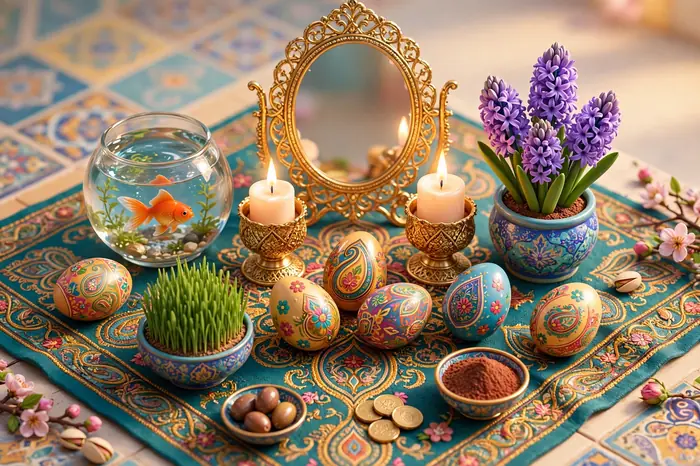
Persian culture is one of the world’s great continuous traditions, and its contributions are visible in daily life far beyond Iran. Nowruz, the Persian New Year celebrated on the spring equinox, is observed by over 300 million people across Central Asia, the Caucasus, and the diaspora, with the Haft-Sin table — seven symbolic items beginning with the Persian letter “sin” — as its centerpiece. The festival was inscribed by UNESCO on its Intangible Cultural Heritage list.
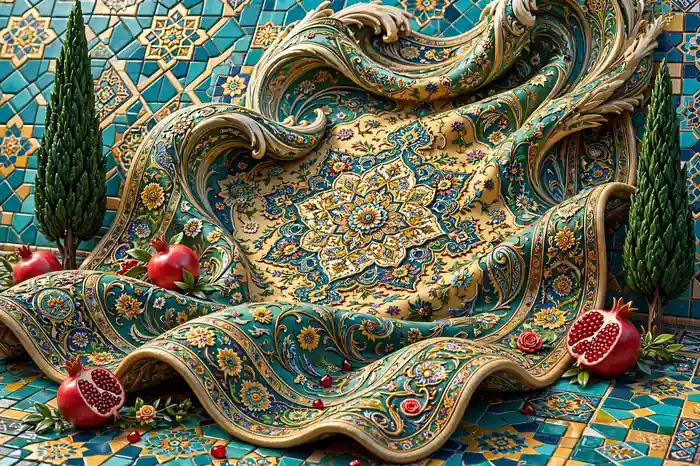
Persian art and craft are equally renowned: hand-knotted Persian rugs remain the global standard of the craft; Persian miniature painting, tilework with its signature turquoise glaze, and calligraphy are masterworks of Islamic art; and Persian architecture — from the soaring domes of Isfahan to the windcatchers of Yazd — shaped building traditions from Samarkand to Delhi.
Persian cuisine introduced the world to dishes like chelow kebab, ghormeh sabzi, and fesenjan, along with saffron, pomegranates, and the ancient art of ice cream (bastani). And in science and philosophy, Persian scholars such as Avicenna (Ibn Sina), whose Canon of Medicine was a standard medical text in Europe for centuries, and the mathematician Al-Khwarizmi (from whose name we get “algorithm”) helped carry knowledge through the Islamic Golden Age into the modern world.
Frequently Asked Questions
What is Persian ethnicity?
Persian ethnicity refers to the ethnic group native to Iran whose mother tongue is the Persian language (Farsi). Persians number around 49 million in Iran — about half the country’s population — and descend from the ancient Indo-Iranian peoples of the Iranian plateau.
Are Persians Arab?
No. Persians are not Arabs. They speak Persian, an Indo-European language, while Arabs speak Arabic, a Semitic language. Persians and Arabs have distinct ethnic origins, histories, and cultures, though both groups are predominantly Muslim today and share centuries of interaction.
Is Persian the same as Iranian?
Not exactly. “Iranian” is a nationality (citizen of Iran); “Persian” is an ethnicity (native Persian speaker identifying with Persian culture). Iran is multiethnic — it includes Azeris, Kurds, Arabs, Baloch, and others who are Iranian but not Persian.
What religion are most Persians?
Most Persians today are Twelver Shia Muslims. Historically, the dominant religion was Zoroastrianism, which survives among small communities in Iran and the Parsi community of India.
Where do Persian people live?
Most Persians live in Iran, with significant populations in Afghanistan and Tajikistan (where they are often called Tajiks), plus large diaspora communities in the United States, Canada, Europe, and the Gulf states.
Who are the Parsis?
The Parsis are descendants of Zoroastrian Persians who migrated from Iran to India over 1,000 years ago. They preserved pre-Islamic Persian religious traditions and became a prominent community in Indian business and culture.
Conclusion
Persian ethnicity is one of humanity’s oldest and richest identities — an Indo-Iranian people whose language, literature, and art have shaped civilization for more than 2,500 years. From the empire of Cyrus the Great to the poetry of Rumi and Hafez, from the turquoise domes of Isfahan to the Nowruz tables set each spring from Tehran to Los Angeles, Persian heritage endures as a living culture, not a museum piece.
Understanding what “Persian” means also means understanding what it is not: it is an ethnicity, not a nationality, and not every Iranian is Persian. That distinction — between the passport and the mother tongue, between the modern state and the ancient civilization — is the key to one of the most commonly asked questions about the Middle East. Whether in Iran or in the global diaspora, Persian identity continues to be defined by what has always defined it: the Persian language and the extraordinary culture built around it.


