
Overbite vs Normal: What Is the Difference?
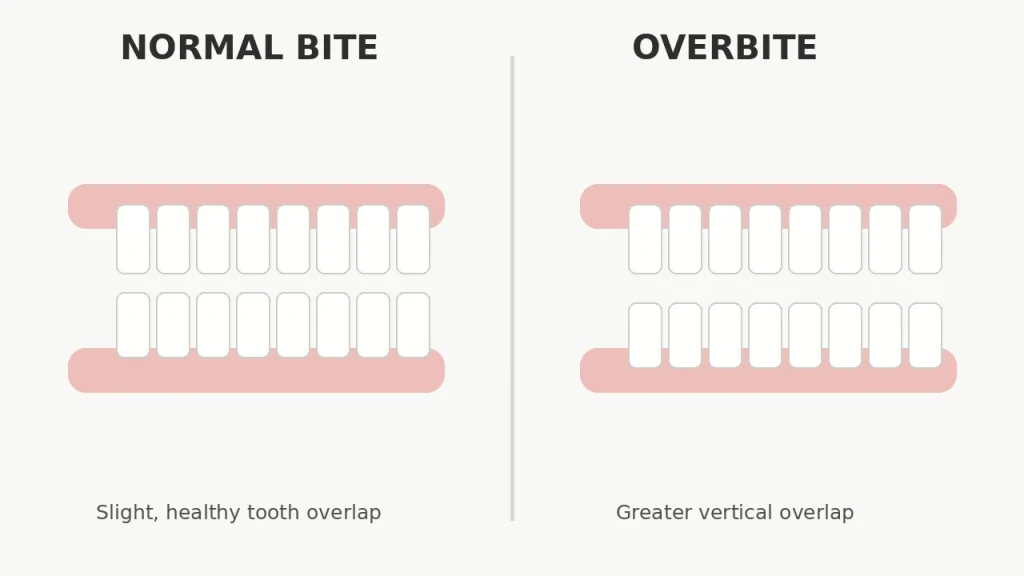
A small amount of overbite is normal. Your upper front teeth should slightly overlap your lower front teeth when you bite down. An overbite becomes a dental concern when the upper teeth cover too much of the lower teeth or affect your comfort, chewing, or oral health.
Your teeth are not supposed to meet in a perfectly straight edge-to-edge position. A healthy bite has a natural relationship between the upper and lower teeth. The upper front teeth usually sit slightly ahead of and overlap the lower front teeth.
The question is how much overlap is present.
What Is a Normal Bite?
A normal bite allows the upper and lower teeth to fit together comfortably when the mouth closes.
The upper front teeth should sit slightly in front of the lower front teeth. They should also overlap the lower front teeth vertically by a small amount.
This arrangement helps the teeth work together during biting and chewing. It also helps distribute pressure across the mouth.
A normal bite does not mean every person’s teeth look exactly the same. Tooth size, jaw shape, facial structure, and natural alignment vary from person to person.
A dentist or orthodontist can determine whether your bite falls within a healthy range.
What Is an Overbite?
An overbite occurs when the upper front teeth overlap the lower front teeth too much vertically.
Dentists may also call a significant overbite a deep bite.
A small amount of overlap is expected. The concern begins when the overlap becomes excessive.
An overbite can be mild, moderate, or severe. The appearance alone does not always tell you how serious it is.
For example, someone may have a noticeable overbite without having pain or difficulty chewing. Another person may have a deeper bite that causes tooth wear or discomfort.
Overbite vs Normal Bite
The easiest way to understand the difference is to look at the amount of vertical overlap.
| Feature | Normal Bite | Overbite |
|---|---|---|
| Upper front teeth | Slightly overlap lower teeth | Cover more of the lower teeth |
| Tooth position | Balanced | Excessive vertical overlap |
| Chewing | Usually comfortable | May become uncomfortable in severe cases |
| Tooth wear | Generally normal | Can increase with excessive contact |
| Gum contact | Usually absent | Severe cases may cause unwanted contact |
| Treatment | Usually unnecessary | May require orthodontic evaluation |
There is no single visual appearance that defines every healthy bite. A professional examination gives a more accurate answer.
How Much Overbite Is Normal?
A small amount of vertical overlap is considered normal.
Cleveland Clinic describes approximately 2 to 4 millimeters of vertical overlap as a typical range. Other orthodontic assessments may describe overbite using the percentage of the lower front teeth covered by the upper teeth.
This means you should not diagnose an overbite simply by looking in the mirror.
The measurement also depends on how the teeth and jaws fit together.
For some people, the overlap may look more noticeable because of tooth shape or facial structure. That does not automatically mean the bite is unhealthy.
What Does a Normal Bite Look Like?
A normal bite generally has several features working together.
The upper front teeth sit slightly ahead of the lower front teeth. The front teeth have a small vertical overlap. The back teeth meet comfortably when you close your mouth.
Your teeth should also work together without excessive pressure on one area.
A healthy bite can support:
- Comfortable chewing
- Normal biting
- Clear speech
- Balanced tooth contact
- Long-term tooth function
The American Association of Orthodontists explains that the upper teeth should slightly overlap the lower teeth in a healthy bite.
What Does an Overbite Look Like?
An overbite can become noticeable when the upper front teeth cover a large portion of the lower front teeth.
In a deeper overbite, the lower front teeth may appear partly hidden when the mouth is closed.
Severe cases can cause the lower teeth to contact the roof of the mouth or the gum tissue behind the upper teeth.
This type of bite is different from an overjet.
An overbite measures vertical overlap.
An overjet measures horizontal projection.
These conditions can occur together, but they describe different relationships between the teeth.
Overbite vs Overjet
People often confuse these two terms.
An overbite describes how much the upper teeth overlap the lower teeth vertically.
An overjet describes how far the upper front teeth extend horizontally beyond the lower front teeth.
For example, imagine looking at your teeth from the side.
If the upper teeth sit too far forward, that is mainly an overjet issue.
If the upper teeth cover too much of the lower teeth from top to bottom, that is an overbite.
You can have one condition without having the other.
What Causes an Overbite?
Several factors can contribute to an excessive overbite.
Genetics
Jaw shape and tooth alignment can run in families.
If close family members have certain bite patterns, you may have a greater chance of developing a similar relationship between your teeth and jaws.
Childhood Habits
Certain habits during childhood can affect dental development.
Prolonged thumb sucking or pacifier use can influence the position of developing teeth. Tongue thrusting can also affect tooth position.
The effect depends on the habit, its duration, and the child’s stage of dental development.
Teeth Grinding
Regular teeth grinding can contribute to abnormal tooth wear.
It does not necessarily cause every overbite, but it can make existing bite problems more complicated.
Tooth Loss
Losing teeth can change how the remaining teeth contact each other.
This may affect the overall bite and create changes that require dental evaluation.
Can an Overbite Cause Problems?
A mild overbite may cause no symptoms at all.
More pronounced cases can create functional or oral health problems.
Possible problems include excessive tooth wear, difficulty chewing, jaw discomfort, and irritation of the gums or tissues.
A severe overbite can also place unusual pressure on certain teeth.
Not every person with an overbite needs treatment. The decision depends on the severity, symptoms, tooth position, jaw structure, and overall oral health.
Overbite and Tooth Wear
Excessive vertical overlap can sometimes cause the teeth to contact each other in ways that create increased wear.
Over time, repeated contact may affect the edges or surfaces of the teeth.
The risk depends on the specific bite pattern and other factors, including grinding.
A dentist can check for signs of abnormal wear during a routine examination.
Overbite and Jaw Pain
An overbite does not automatically cause jaw pain.
However, an abnormal bite can sometimes contribute to problems involving the jaw and chewing muscles.
If you experience persistent jaw pain, clicking, stiffness, headaches, or difficulty opening your mouth, a dental or orthodontic assessment can help identify the cause.
These symptoms can have several possible causes, so they should not automatically be blamed on an overbite.
Does Everyone With an Overbite Need Braces?
No.
A small overbite is part of normal dental anatomy.
Treatment is generally considered when the bite is significantly misaligned or creates functional, dental, or comfort problems.
If treatment is appropriate, an orthodontist may recommend braces or clear aligners. The treatment plan depends on the person’s teeth, jaw development, age, and severity of the problem.
Severe cases involving the jaw may require more complex treatment.
How Is an Overbite Diagnosed?
A dentist can usually identify an overbite during a dental examination.
An orthodontist can perform a more detailed assessment of the teeth and jaws.
The examination may include:
- Visual inspection
- Bite measurements
- Photographs
- Dental impressions or digital scans
- Dental X-rays when needed
These tools help determine whether the issue involves the teeth, the jaws, or both.
How Is an Overbite Treated?
Treatment depends on the cause and severity.
Braces
Traditional braces can gradually move teeth into better positions.
They are commonly used for many types of bite problems.
Clear Aligners
Clear aligners can correct certain overbite cases by applying controlled pressure to the teeth.
They are not suitable for every case, so an orthodontist needs to assess the bite before recommending them.
Growth-Based Treatment
Children and teenagers may have additional treatment options because their jaws are still developing.
Orthodontists can sometimes use appliances to guide dental and jaw development.
Corrective Jaw Surgery
Very severe skeletal problems may require orthognathic surgery.
This approach is generally reserved for cases where the relationship between the jaws cannot be adequately corrected with orthodontic treatment alone.
Overbite vs Normal in Children
Children’s bites change as their teeth and jaws develop.
A child’s bite should therefore be evaluated in the context of their stage of growth.
Some dental habits can influence developing teeth, especially when they continue for an extended period.
Parents should speak with a dentist or orthodontist if they notice significant tooth overlap, difficulty biting, unusual jaw movement, or other concerns.
Early evaluation does not necessarily mean a child needs immediate treatment.
It simply gives the dental professional an opportunity to monitor development and decide if treatment may be useful later.
Overbite vs Normal in Adults
Adults can also have their overbite evaluated and treated.
Age does not automatically prevent orthodontic treatment.
Braces and clear aligners may be used for many adult bite problems. More complex skeletal cases may require additional treatment.
The important question is whether the bite is healthy, functional, and comfortable.
If your upper teeth cover a large portion of your lower teeth, a dentist or orthodontist can measure the relationship instead of relying on appearance alone.
Can You Fix an Overbite Naturally?
An established dental overbite generally cannot be corrected through exercises or home remedies.
The position of teeth and jaws is influenced by bone structure, tooth position, and growth.
Orthodontic treatment is the standard approach for moving teeth into a different position.
Some online exercises claim to correct an overbite, but they should not replace professional dental evaluation.
When Should You See a Dentist?
Consider a dental or orthodontic evaluation if you notice:
- Upper teeth covering most of the lower teeth
- Lower teeth touching the roof of the mouth
- Significant tooth wear
- Difficulty biting or chewing
- Persistent jaw discomfort
- A bite that has changed noticeably
- Problems closing your mouth comfortably
A professional can determine whether the bite is normal or needs treatment.
Common Misunderstandings About Overbite
One common misunderstanding is that any overlap between the upper and lower front teeth means something is wrong.
That is incorrect.
Some overlap is normal and expected.
Another misconception is that an overbite is the same as buck teeth.
That is also incorrect.
Buck teeth generally refer to an overjet, which involves horizontal projection of the upper front teeth.
An overbite involves vertical overlap.
A third misconception is that every overbite requires braces.
Treatment is not necessary for every mild overbite. The need for treatment depends on the individual case.
Frequently Asked Questions
Is an overbite normal?
A small amount of overbite is normal. The upper front teeth are expected to slightly overlap the lower front teeth.
What is the difference between an overbite and a normal bite?
A normal bite has a small, functional overlap between the upper and lower front teeth. An excessive overbite occurs when the upper teeth cover too much of the lower teeth.
How many millimeters is a normal overbite?
A vertical overlap of roughly 2 to 4 millimeters is commonly described as typical. Dental professionals may also assess overbite by percentage and by looking at the complete bite relationship.
Is a 2 mm overbite normal?
A 2 mm overbite generally falls within the range commonly described as normal. Your dentist can confirm whether your complete bite is healthy.
Is a 4 mm overbite normal?
Around 4 mm can still fall within commonly cited typical measurements. The overall bite relationship matters, so measurement alone does not determine whether treatment is needed.
What is considered a deep overbite?
A deep overbite occurs when the upper front teeth excessively cover the lower front teeth. The severity can be assessed using measurements and the amount of lower-tooth coverage.
Is an overbite the same as an overjet?
No. An overbite measures vertical overlap, while an overjet measures the horizontal distance between the upper and lower front teeth.
Can an overbite cause tooth problems?
A significant overbite can contribute to excessive tooth wear or unwanted contact with gum or oral tissues. Mild cases may cause no problems.
Do you need braces for an overbite?
Not always. Mild overbites may not require treatment. Braces, clear aligners, or other orthodontic options may be recommended when the bite causes functional or dental concerns.
Can adults fix an overbite?
Yes. Adults can receive orthodontic treatment for many overbite problems. The appropriate treatment depends on the teeth, jaws, severity, and individual goals.
Final Takeaway
The difference between overbite vs normal comes down to the amount and effect of vertical overlap.
A normal bite has a small amount of overlap between the upper and lower front teeth. An excessive overlap is considered an overbite or deep bite.
A mild overbite may be completely manageable without treatment. A more severe bite can contribute to tooth wear, tissue irritation, chewing problems, or jaw discomfort.
If you are unsure about your bite, a dentist or orthodontist can measure it and explain whether your tooth and jaw relationship is within a healthy range.