Beyond 15 Minutes: Why the “Flow Rate” is the Most Critical Part of Your Safety Shower Audit
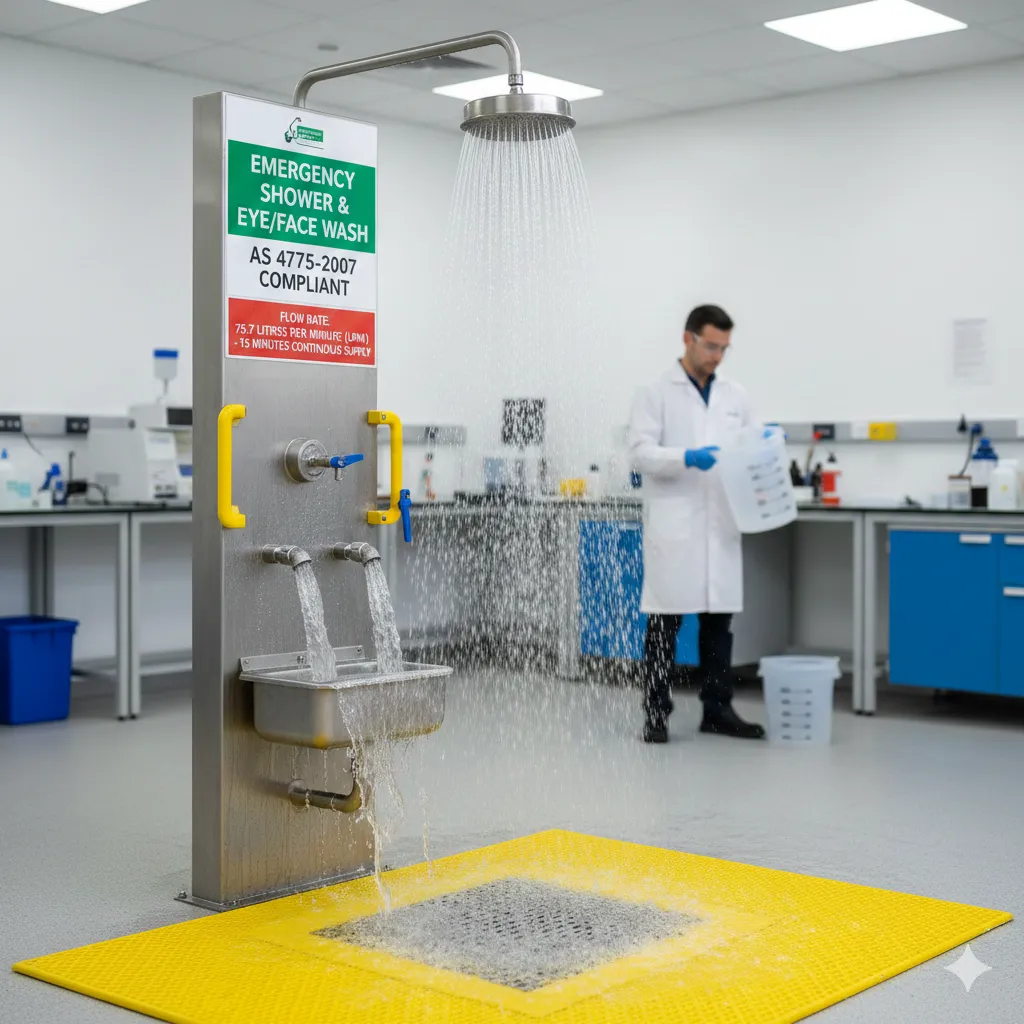
An emergency safety shower will remain an inalienable part of a strong Work Health and Safety (WHS) strategy in an industrial or laboratory environment. The majority of safety managers are extremely familiar with the so-called 15-minute rule, which states that a unit should supply a constant supply of water for 15 minutes to effectively dilute and spray the dangerous contaminants.
The Australian Standard for Emergency Safety Shower Performance
AS 4775-2007 is the governing Standard of decontamination equipment in Australia. This criterion is so particular concerning what an effective flush is. Most people think that it is only water flowing which is good as opposed to none flowing, the Australian Standard specifies that an emergency safety shower shall provide at least 75.7 litres of flushing fluid per minute.
The calculation of this volume is done to make sure that the size of the drench is large enough to cover the entire body at once, which is critical when working with corrosive splashes that can be transferred quickly across the skin.
Why Flow Rate Outweighs Duration in an Audit
The 15-minute safety shower, which supplies 40 litres in one minute, is fundamentally not compliant, and in addition to that, it is not safe. The low flow rates tend to produce a narrow and weak spray pattern, which cannot achieve the minimum required diameter of 508mm at the level of 1524mm on the floor. In case the water is not able to function properly to cover the affected region, the chemical will be left on the skin, still damaging the tissues of the user as long as he/she remains standing under the unit.
The Risks of Inadequate Pressure
- Partial Decontamination: Lack of volume is unable to penetrate clothing or dense chemical residues.
- Problems with Thermal Shocks: Low flow may cause fluctuation in temperature in units that employ tepid water, which adds more misery to the casualty.
- Simultaneous Use Failure: Combination units. In combination units, the flow rate should remain constant even when the eye wash is operating at the same time.
Summary
Although the most well-known part of a safety response is the 15 minutes, the flow rate is the one that fills heavy work during an accident. The audit of the emergency safety shower should ensure that the plumbing is capable of handling the large amount of water that is needed to save workers during the critical seconds after exposure. With the primary focus on flow rate and regular testing, Australian businesses will be able to make sure that their first-aid infrastructure will be available when it is most necessary. Investing in safety shower technology allows companies like Spill Station, Australia https://www.spillstation.com.au/ , to report shorter reaction times and reduce injury severity.