
MamaisGuitars Com: Handmade Guitars, Greek Musical Heritage and the Craft Behind Them
MamaisGuitars Com is a domain associated with traditional musical instrument craftsmanship, handmade guitars, and the cultural heritage of Greek string instruments. Its historical background is connected with the Mamais Guitars name and specialist instrument making, including guitars designed for different musical styles, from Greek folk and rebetiko to European Gypsy jazz.
This guide explains what MamaisGuitars Com is, who Spiros Mamais was, how a handmade guitar is actually built, what makes a Manouche guitar different, what the santouri is, and how to judge a handmade instrument before buying one. It also explains why the domain’s history and its current website should be checked separately before anyone tries to order an instrument.
Quick Info
- Subject: MamaisGuitars Com — traditional Greek instrument craftsmanship and handmade guitars
- Name behind it: Spiros Mamais, Greek craftsman and luthier
- Specialities: Handmade acoustic guitars, Manouche (Gypsy jazz) guitars, traditional Greek string instruments, santouri
- Key idea: Every instrument is built for a musical style — rhythm, melody and jazz each need different construction
- Before buying: Verify the current website, ownership and product availability independently
Table of Contents
- Quick Answer: What Is MamaisGuitars Com?
- Historical Background of Mamais Guitars
- Who Was Spiros Mamais?
- The Art of Handmade Guitar Construction
- Understanding Manouche Guitars
- Traditional Greek Guitars and Their Musical Role
- Santouri: An Important Greek String Instrument
- How Wood Selection Affects Guitar Quality
- Guitar Design and Sound Production
- Handmade Guitars Compared With Factory-Made Instruments
- The Importance of Guitar Setup
- Maintenance and Long-Term Instrument Care
- The Cultural Value of Traditional Greek Instruments
- The Changing Online Identity of MamaisGuitars Com
- Frequently Asked Questions
- Conclusion
Quick Answer: What Is MamaisGuitars Com?
MamaisGuitars Com is a website domain historically associated with Mamais Guitars and Greek musical instrument construction. Its identity is connected with handmade string instruments and specialised guitar designs used in different musical traditions, including Manouche guitars for Gypsy jazz, traditional Greek guitars for folk and rebetiko ensembles, and the santouri, a hammered dulcimer played with small beaters.
The name matters because instrument making is not limited to producing standard acoustic guitars. Different musical styles require different construction characteristics: an instrument designed for rhythmic accompaniment may have different requirements from one intended for melodic performance or jazz improvisation. The historical identity of MamaisGuitars Com should be distinguished from the present operation of its website, because a domain name alone cannot confirm whether an original workshop continues to operate or whether products and services remain available.
Historical Background of Mamais Guitars
The Mamais Guitars name is associated with Spiros Mamais, a Greek craftsman connected with handmade guitars and traditional string instruments. Greek musical culture includes several distinctive traditions, each with particular instrumental requirements. Folk music, urban musical styles such as rebetiko, and European jazz have all encouraged instrument makers to develop specialised knowledge and construction techniques.
The work associated with specialist builders involves understanding how musicians actually use their instruments. That means considering string arrangements, body dimensions, sound projection, and playing comfort — not as abstract specifications, but as answers to the question of what a working musician needs on stage or in a taverna. The historical background of Mamais Guitars reflects the relationship between traditional musical practices and independent craftsmanship. Such makers contribute to musical culture by creating instruments that support established performance styles, and by repairing and maintaining the instruments that keep those styles alive.
Who Was Spiros Mamais?
Spiros Mamais was a Greek luthier whose name became attached to handmade guitars and traditional string instruments. Public information about his life is limited, and the details that circulate about him come largely from the instrument-making community and from the reputation of the instruments themselves, rather than from a single published biography.
What can be said with confidence is that his work sits in a long Greek tradition of independent luthiers: craftsmen who learned by apprenticeship, built in small workshops, and judged their work by how an instrument sounded in a musician’s hands rather than by how many units left the bench. That tradition is the real subject of MamaisGuitars Com — a name that stands for a way of building, not just a brand.
The Art of Handmade Guitar Construction
Building a guitar requires a combination of woodworking ability, technical accuracy, and knowledge of acoustic principles. The process begins with designing the instrument. Important measurements include body dimensions, neck length, bridge placement, and fingerboard positioning. These elements must work together to produce a stable and playable instrument.
The builder then selects and prepares the wood. The soundboard, back, and sides form the main acoustic body, while internal bracing provides structural support. Each component must be assembled carefully to maintain strength and encourage appropriate soundboard vibration. Finishing work is equally important: fret alignment, string height, bridge positioning, and neck adjustment influence how comfortably the instrument can be played.
In a small workshop, the builder can inspect every component as the work progresses and adjust it by hand. A soundboard that is slightly too stiff can be thinned; a neck angle that is slightly off can be corrected before the frets go on. That freedom to adjust during construction is the practical advantage of handmade work, and it is why two guitars from the same maker can still feel like individuals rather than copies.
Understanding Manouche Guitars
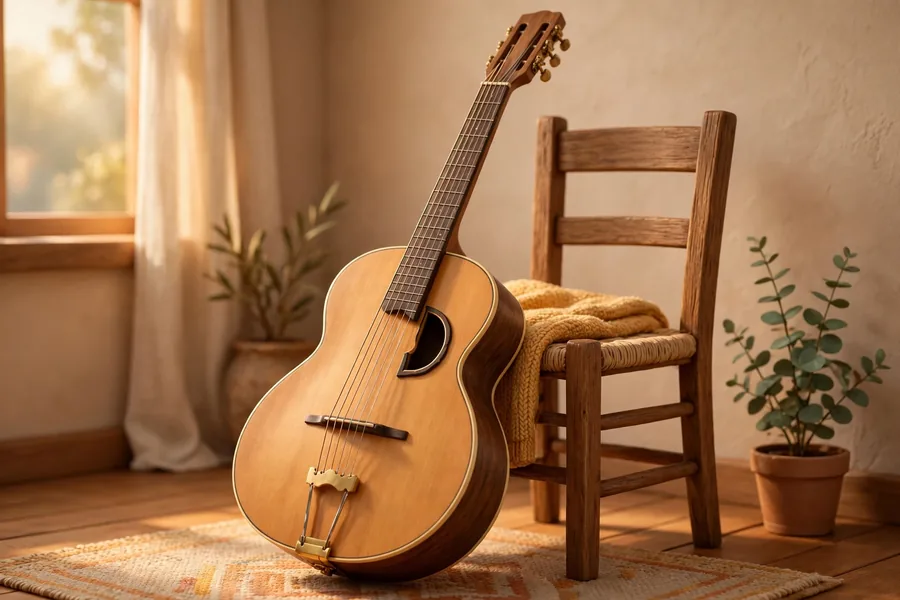
Manouche guitars are closely connected with European Gypsy jazz, the style pioneered by Django Reinhardt in the 1930s. This musical style combines energetic rhythmic accompaniment — the driving “la pompe” strum — with expressive melodic improvisation, and it demands an instrument that can do both at volume without amplification.
These guitars have distinctive construction characteristics that separate them from many conventional acoustic models. Depending on the design, features may include specialised soundholes — the small oval hole or the large D-shaped hole — particular bridge arrangements, a longer scale length, light bracing, and body shapes developed to support acoustic projection. The result is a bright, cutting, percussive voice that carries across a room full of other instruments.
Musicians often use rapid picking techniques and strongly articulated rhythms when playing this style. Therefore, an appropriate guitar should provide clear notes, responsive sound, and comfortable handling at speed. The historical connection between MamaisGuitars Com and Manouche guitar craftsmanship highlights the specialised knowledge required to produce instruments for particular musical traditions: a maker who understands Gypsy jazz builds a different guitar from one who builds for classical or folk music.
Traditional Greek Guitars and Their Musical Role
Guitars are used in different forms of Greek music, particularly as supporting instruments in ensembles. Their responsibilities may include providing rhythmic patterns, supporting harmonies, accompanying singers, and occasionally performing melodic passages. Their playing characteristics depend on the musical arrangement and the instruments accompanying them.
In traditional performances, guitars often work alongside instruments responsible for carrying the main melody, such as the bouzouki or the violin. Clear chord definition and balanced volume help maintain the overall musical structure: the guitar holds the harmony together while the lead instrument sings above it. In rebetiko, the guitar’s steady accompaniment is part of the sound itself, not background filler.
Traditional instrument construction reflects these performance requirements. Builders familiar with Greek musical practices can consider the needs of musicians when selecting designs and adjusting instruments — a slightly smaller body for a player who travels between venues, a warmer tone for an ensemble that already has bright lead instruments, or a tougher finish for an instrument that will be played outdoors in summer heat.
Santouri: An Important Greek String Instrument
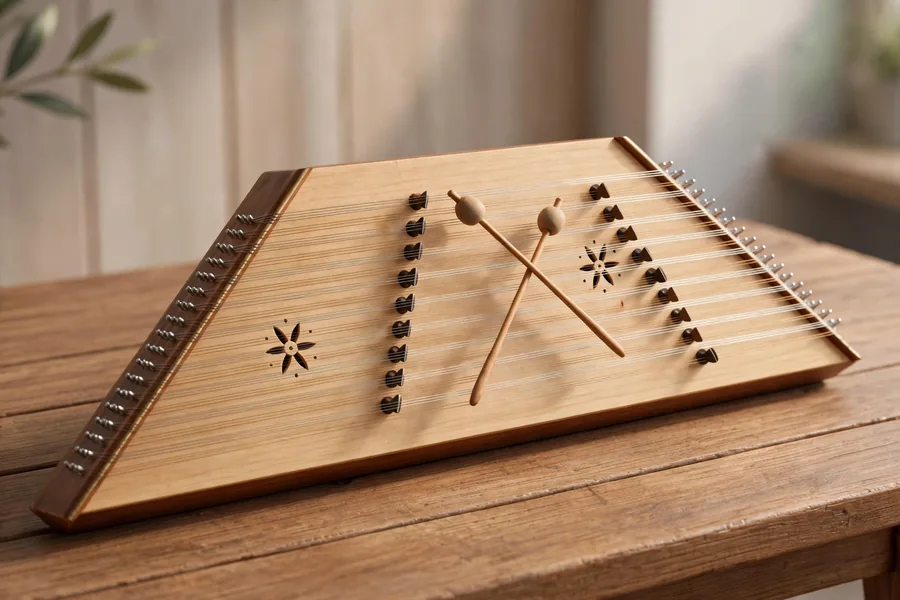
The santouri is a traditional Greek instrument belonging to the hammered dulcimer family. Unlike a guitar, which produces sound through plucking or strumming, the santouri creates notes when a musician strikes its strings using small beaters. It is the Greek cousin of instruments found across Europe and the Middle East, including the cimbalom and the Persian santoor.
Its structure generally includes a wooden resonating body, multiple strings, and bridges supporting the string arrangement. Different strings produce different pitches, allowing musicians to perform melodies and musical patterns. The sound is bright and shimmering, and the instrument can carry both melody and accompaniment in folk ensembles.
Constructing a santouri requires careful attention to structural strength. The numerous strings create considerable tension, so the wooden body must remain stable. Bridge positioning and soundboard construction also influence its acoustic response. The association of MamaisGuitars Com with traditional instruments demonstrates a broader interest in specialist musical craftsmanship beyond conventional guitars — a workshop that builds santouri as well as guitars is serving a whole musical culture, not a single product line.
How Wood Selection Affects Guitar Quality
Wood is one of the most important materials used in acoustic instrument construction. Different varieties have different levels of density, stiffness, and resistance to environmental changes. Spruce is the classic soundboard wood because it is light and stiff, giving a clear, projecting tone; cedar is warmer and responds more easily to a light touch; rosewood backs add richness and depth, while maple gives brightness and definition.
The soundboard must respond to string vibrations while maintaining sufficient strength. The neck needs stability to support string tension and preserve its alignment. Meanwhile, the back and sides contribute to the instrument’s structure and acoustic characteristics. Proper preparation is also essential: wood with excessive moisture can change shape after construction, potentially affecting joints and playing conditions.
Experienced builders therefore consider both material quality and preparation methods before beginning assembly. Well-seasoned wood, stored for years and dried slowly, is one of the quiet differences between a good instrument and a great one — and one of the reasons handmade guitars from small workshops can sound better than their price suggests.
Guitar Design and Sound Production
An acoustic guitar produces sound through the interaction of its strings and wooden body. When a musician plays a string, its vibrations travel through the bridge into the soundboard. The body then helps amplify and shape the resulting sound. Several construction details influence the final tone, including body dimensions, soundboard thickness, internal bracing, bridge design, and string selection.
Different musicians also have different expectations. Some prefer strong rhythmic projection, while others prioritise individual note clarity and melodic expression. This explains why specialist instrument makers develop different designs for different musical requirements — and why the same player may own one guitar for rhythm work and another for solo playing.
Handmade Guitars Compared With Factory-Made Instruments
Handmade and factory-produced guitars differ mainly in their manufacturing processes and production methods. Independent workshops generally produce fewer instruments, allowing builders to inspect individual components and make adjustments during construction. They may also provide greater flexibility in dimensions, materials, and finishing preferences.
Factory production uses standardised measurements, machinery, and repeatable procedures. This approach supports consistent manufacturing and makes instruments available at different prices. However, handmade construction does not automatically guarantee superior quality. Both types of guitars should be evaluated according to their sound, comfort, durability, and overall performance.
| Feature | Handmade guitars | Factory-made guitars |
|---|---|---|
| Production volume | Few instruments per year | Thousands per year |
| Adjustments during build | Individual, by hand | Standardised procedures |
| Customisation | Dimensions, woods and finish to order | Fixed models and options |
| Consistency | Each instrument is individual | Very consistent from unit to unit |
| Price range | Usually higher | Wide, from budget to premium |
| Best judged by | Sound, comfort and response in your hands | Sound, comfort and response in your hands |
The Importance of Guitar Setup
A guitar’s performance depends on more than its original construction. Proper setup helps ensure comfortable playing and accurate musical results. String action refers to the distance between the strings and the fingerboard. Excessively high action can make playing difficult, while very low action may cause unwanted buzzing.
Other important adjustments include neck curvature, fret condition, nut positioning, saddle height, and intonation. These details help musicians play comfortably and produce accurate notes across the fingerboard. A well-made guitar with a poor setup will play worse than a modest guitar with a good one, which is why experienced players budget for a professional setup after buying any instrument, handmade or factory-made.
Maintenance and Long-Term Instrument Care
Regular maintenance helps preserve an acoustic guitar’s condition. Musicians should replace worn strings, clean the instrument using suitable products, and inspect important components regularly. The fingerboard and body should be kept free from excessive dirt and moisture.
Humidity is another important consideration. Very dry conditions can cause wooden components to shrink, while excessive moisture may lead to swelling and structural movement. Proper storage and occasional professional inspections can help prevent avoidable damage. A guitar kept in a stable environment, in its case when not played, will outlast one left leaning against a radiator or in a damp room by decades.
The Cultural Value of Traditional Greek Instruments
Traditional instruments represent an important part of cultural identity. Their construction methods and playing techniques develop through generations of musicians and craftspeople. Greek music includes several instrumental traditions that contribute distinctive sounds to regional performances. Some instruments provide rhythm, others carry melodies, and some support singers.
Instrument makers help preserve these traditions by producing, repairing, and maintaining the instruments used by musicians. The historical background of MamaisGuitars Com can therefore be understood through the wider relationship between musical heritage and traditional craftsmanship. When a workshop closes, the knowledge of how to build for a particular style can disappear with it — which is why the names of makers like Spiros Mamais are remembered long after their instruments have changed hands.
The Changing Online Identity of MamaisGuitars Com
Internet domains can retain historical associations even when their original websites change or become inactive. A business might initially use its domain to display instruments, introduce its workshop, or provide customer contact information. Over time, the website may be redesigned, become unavailable, or develop a different purpose.
MamaisGuitars Com is an example of why historical identity and current website activity should be considered separately. Visitors interested in purchasing instruments or contacting the original business should independently verify current website information, ownership, product availability, and contact details before sending money or personal information. A domain’s history is not a guarantee of its present operation.
Frequently Asked Questions
What is MamaisGuitars Com?
MamaisGuitars Com is a domain historically associated with the Mamais Guitars name, Greek instrument craftsmanship, and handmade string instruments, including Manouche guitars, traditional Greek guitars and the santouri.
Who is associated with Mamais Guitars?
The name is historically associated with Spiros Mamais, a Greek craftsman connected with handmade guitars and traditional musical instruments.
What are Manouche guitars?
Manouche guitars are acoustic instruments associated with European Gypsy jazz. They are designed to support rhythmic accompaniment and melodic improvisation, with a bright, percussive voice that carries without amplification.
What is a santouri?
A santouri is a traditional hammered dulcimer instrument. Musicians produce sound by striking its strings with small beaters. It is used in Greek folk music and related traditions.
Why is handmade guitar construction important?
Handmade construction allows individual attention to materials, measurements, assembly, and finishing. These factors can influence sound quality and playing comfort, and they allow the builder to adjust the instrument to a musician’s needs during the build.
Does MamaisGuitars Com currently sell guitars?
Its historical association with guitar craftsmanship does not confirm current product availability. Visitors should independently check the website and verify its business information before trying to buy.
How can acoustic guitars be maintained?
Regular string replacement, suitable cleaning, humidity control, proper storage, and professional adjustments help maintain an acoustic guitar.
What wood is best for a handmade guitar soundboard?
Spruce is the classic choice for clarity and projection, while cedar gives a warmer tone and responds more easily to a light touch. The best choice depends on the player’s style and the sound they want.
Conclusion
MamaisGuitars Com represents an interesting connection between Greek musical heritage, handmade guitar construction, and traditional instrument craftsmanship. Its historical background is associated with Spiros Mamais and specialist instruments, including Manouche guitars, traditional Greek guitars, and the santouri.
Exploring this subject demonstrates how woodworking, material selection, acoustic design, and careful setup contribute to instrument quality. It also highlights the importance of understanding the musical traditions for which particular instruments are created — a guitar built for Gypsy jazz is not the same instrument as one built for rebetiko accompaniment, and a maker who understands both is serving two cultures at once.
Although the domain has historical associations with musical craftsmanship, its current commercial activities require independent verification. Nevertheless, the subject provides valuable insight into the continuing relationship between traditional instrument makers, musicians, and cultural preservation. For more on musical heritage, see Gypsy jazz, rebetiko and the hammered dulcimer family to which the santouri belongs.