
James Quincey and Howard Schultz: Leadership and Business Success
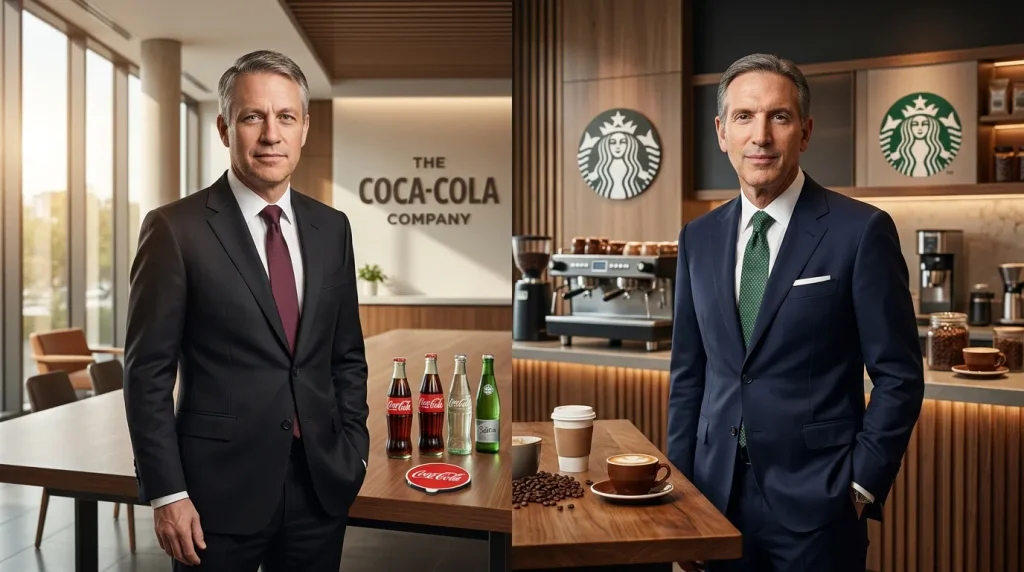
James Quincey and Howard Schultz are associated with two of the most influential consumer brands in the world: Coca-Cola and Starbucks.
Their careers followed very different paths. Quincey spent nearly three decades rising through Coca-Cola’s global corporate structure. Schultz joined a small Seattle coffee company, left to pursue his own vision, and later returned to help build Starbucks into a global brand.
They are not known for a direct professional partnership. The connection between James Quincey and Howard Schultz is mainly comparative. Both are business leaders who helped shape major consumer companies. However, their leadership styles, industries, business models, and paths to success are very different.
There is also an important 2026 update. James Quincey is no longer Coca-Cola’s CEO. He stepped down from the role on March 31, 2026, and now serves as Executive Chairman. Henrique Braun succeeded him as CEO. Howard Schultz, meanwhile, is no longer a Starbucks director or CEO. He remains the company’s Chairman Emeritus and continues to be involved in business and philanthropic activities. (Coca-Cola Company)
James Quincey and Howard Schultz at a Glance
| Area | James Quincey | Howard Schultz |
|---|---|---|
| Primary industry | Non-alcoholic beverages | Coffee and food retail |
| Best known for | Long career at Coca-Cola | Building modern Starbucks |
| Current connection | Executive Chairman of Coca-Cola | Starbucks Chairman Emeritus |
| Career path | Rose through corporate leadership | Entrepreneurial transformation |
| Leadership focus | Global operations and portfolio strategy | Brand experience and company culture |
| Major company | The Coca-Cola Company | Starbucks |
| Global growth model | Products and distribution | Physical coffeehouses and customer experience |
| Key business challenge | Transforming a legacy beverage company | Scaling a coffeehouse concept globally |
The comparison is useful because each leader represents a different model of executive success.
Quincey inherited responsibility for one of the world’s largest beverage systems. Schultz helped redefine what a coffee company could become.
Who Is James Quincey?
James Quincey is a British business executive who built his career through Coca-Cola’s international operations.
He joined The Coca-Cola Company in 1996 and held leadership positions across Latin America, Mexico, Europe, and other global markets before becoming chief executive officer in 2017.
Quincey became chairman of Coca-Cola’s board in 2019.
His tenure as CEO ended on March 31, 2026, when Henrique Braun succeeded him. Quincey continued with the company as Executive Chairman of the Board. (Coca-Cola Company)
This leadership transition is important because many older articles still describe Quincey as Coca-Cola’s current CEO.
James Quincey’s Early Career
Before joining Coca-Cola, Quincey worked in strategy consulting.
He later joined Coca-Cola in Atlanta as Director of Learning Strategy for the Latin America Group.
His international experience became one of the defining features of his career.
He worked through several operational roles in Latin America before becoming President of the South Latin Division. He later led Coca-Cola’s Mexico division and held senior positions in Europe.
His career included major roles such as:
- President of the South Latin Division
- President of Coca-Cola’s Mexico Division
- President of the Northwest Europe and Nordics business unit
- President of Coca-Cola’s Europe Group
- President and Chief Operating Officer
- Chief Executive Officer
- Chairman of the Board
- Executive Chairman
Coca-Cola’s official leadership information describes Quincey’s career as a series of global leadership roles that began when he joined the company in 1996. (Coca-Cola Company)
James Quincey’s Rise Through Coca-Cola
Quincey’s path to the top was not based on entering directly as CEO.
He spent years working inside different markets.
That experience mattered because Coca-Cola operates through a complex global system. Consumer behavior can differ significantly between countries. A strategy that succeeds in Mexico may not work in Europe or Asia.
Quincey’s earlier positions gave him exposure to:
- Regional consumer behavior
- Bottling operations
- Product development
- Pricing strategy
- Distribution
- Brand management
- International markets
He became President and Chief Operating Officer in 2015 before taking over as CEO in 2017.
His experience in different regions helped prepare him for responsibility over the wider Coca-Cola system. (Coca-Cola Company)
James Quincey’s Transformation of Coca-Cola
One of the central themes of Quincey’s leadership was Coca-Cola’s move toward becoming a broader beverage company.
For decades, Coca-Cola’s identity was strongly connected with carbonated soft drinks.
However, the global beverage market continued to change.
Consumers showed growing interest in:
- Bottled water
- Coffee
- Tea
- Sports drinks
- Juices
- Dairy alternatives
- Reduced-sugar drinks
- Zero-sugar products
The challenge was clear.
Coca-Cola needed to adapt to changing consumer preferences without weakening its most valuable brands.
The company’s succession announcement credited Quincey’s leadership with transforming Coca-Cola into a total beverage company. It also stated that the company added more than 10 additional billion-dollar brands during his leadership period. (Coca-Cola Investors)
This transformation was one of the defining aspects of his time as CEO.
Coca-Cola’s Global Business Model
James Quincey led a business that already had enormous global reach.
This meant his challenge was different from building a startup or launching a new company.
Coca-Cola had:
- Established brands
- Global recognition
- Large bottling partners
- Extensive distribution systems
- Major retail relationships
- Operations across international markets
The leadership challenge was not simply expansion.
It involved making a massive organization more responsive to consumers.
A global consumer company cannot change direction quickly without affecting bottlers, retailers, suppliers, employees, and investors.
Quincey’s leadership therefore required coordination across a highly complex corporate system.
Who Is Howard Schultz?
Howard Schultz is the businessman most closely associated with building Starbucks into the global coffeehouse brand known today.
He joined Starbucks in 1982.
At the time, the company was much smaller and focused mainly on selling coffee beans and related products.
A visit to Italy changed Schultz’s view of the business.
He was influenced by Italian coffee bars and saw an opportunity to create a different kind of coffee experience in the United States.
The idea was not simply to sell coffee.
It was to create a place where people could gather.
Starbucks later became closely connected with the concept of the third place, meaning a social environment between home and work.
The Starbucks timeline shows that Schultz joined the company in 1982, traveled to Italy in 1983, founded Il Giornale in 1985, and acquired Starbucks assets in 1987 with local investors. (Starbucks)
Howard Schultz and the Creation of Modern Starbucks
Howard Schultz did not originally create Starbucks in 1971.
However, he played the central role in transforming the company’s business model.
Starbucks began as a Seattle coffee retailer.
Schultz believed the company could become much more.
After leaving Starbucks, he founded Il Giornale. The business sold espresso drinks and brewed coffee using Starbucks beans.
In 1987, Il Giornale acquired Starbucks and adopted the Starbucks name.
The company then began its rapid expansion.
This distinction matters when discussing Schultz’s role.
He is widely described as Starbucks’ modern-day founder because of his role in building the company into the global coffeehouse business people recognize today.
Howard Schultz’s Leadership Philosophy
Schultz’s approach placed heavy emphasis on the relationship between:
- Employees
- Customers
- Coffee
- Store atmosphere
- Brand identity
- Community
He believed a successful consumer business needed to offer more than a product.
The environment around the purchase mattered.
A Starbucks customer could:
- Meet friends
- Work
- Study
- Hold a casual meeting
- Spend time outside the home
- Visit regularly as part of a daily routine
This became one of the most important differences between Starbucks and a traditional coffee retailer.
The coffeehouse itself became part of the product.
Starbucks and the Third Place
The idea of the third place became strongly associated with Howard Schultz and Starbucks.
Home represents one place.
Work represents another.
The coffeehouse can become a third social environment.
This concept influenced:
- Store design
- Seating
- Music
- Customer service
- Product presentation
- Brand communication
Schultz continued to discuss the importance of the third place even after leaving the CEO role.
In a 2025 discussion with Starbucks CEO Brian Niccol, Schultz emphasized that the concept remained central to the company’s identity and future. (Starbucks)
Howard Schultz’s Different Periods as Starbucks CEO
Schultz led Starbucks during several important periods.
His career included:
- Building Starbucks after the 1987 acquisition
- Serving as CEO during the company’s early growth
- Returning as CEO during a difficult period in 2008
- Later returning as interim CEO in 2022
He stepped down as Starbucks’ interim CEO in 2023 and retired from the company’s board of directors the same year.
Starbucks honored him as Chairman Emeritus. (Starbucks Investor Relations)
This is another important update for readers.
Howard Schultz is not the current CEO of Starbucks.
Brian Niccol is Starbucks’ chairman and CEO.
Schultz remains Chairman Emeritus and continues to provide perspective on the company’s culture and history. (Starbucks)
James Quincey vs Howard Schultz: Different Leadership Paths
The biggest difference between James Quincey and Howard Schultz is how they reached leadership.
Quincey followed a traditional corporate path.
He entered a large multinational company and worked through increasingly senior positions.
Schultz followed a more entrepreneurial path.
He saw an opportunity inside the coffee industry, developed his own business concept, and helped transform Starbucks into a global brand.
Their paths can be summarized simply.
James Quincey
His career was built around:
- Corporate leadership
- International management
- Operational strategy
- Portfolio transformation
- Global distribution
- Long-term corporate planning
Howard Schultz
His career was built around:
- Entrepreneurial vision
- Brand building
- Customer experience
- Store culture
- Employee relationships
- Global retail expansion
Neither approach is automatically better.
The right leadership model depends on the business.
James Quincey’s Leadership Style
Quincey’s leadership is closely associated with organizational transformation.
He managed a company that already had global recognition.
His challenge was adapting Coca-Cola for the future.
That required attention to:
- Consumer trends
- Product portfolios
- Global markets
- Bottling relationships
- Technology
- Marketing
- Operations
Coca-Cola’s current leadership transition also highlights the company’s continued focus on becoming closer to consumers and accelerating digital transformation. (Coca-Cola Company)
This helps explain the environment in which Quincey led.
The company was not trying to abandon its traditional strengths.
It was trying to expand those strengths into a changing consumer market.
Howard Schultz’s Leadership Style
Schultz placed more visible emphasis on emotional connection.
He believed the relationship between a company and its people could become a competitive advantage.
His leadership philosophy often connected business performance with:
- Employee experience
- Customer loyalty
- Brand culture
- Social connection
- Community
This approach became a major part of the Starbucks identity.
The company expanded beyond selling coffee.
It built a recognizable experience around coffee.
That experience became one of Starbucks’ strongest competitive advantages.
Corporate Transformation vs Brand Experience
The comparison between James Quincey and Howard Schultz can be understood through one important contrast.
Quincey focused heavily on transforming a corporate system.
Schultz focused heavily on building a customer experience.
Quincey’s work involved:
- Global operations
- Portfolio strategy
- Corporate structure
- Bottling partnerships
- International growth
Schultz’s work involved:
- Coffeehouse design
- Brand identity
- Customer experience
- Employee culture
- Retail expansion
Both leaders understood that a powerful brand needs to evolve.
They simply approached that challenge from different directions.
Global Expansion: Coca-Cola and Starbucks
Both Coca-Cola and Starbucks became global companies.
However, their expansion models differ.
Coca-Cola sells products through a vast distribution network.
Its growth depends heavily on:
- Manufacturing
- Bottling
- Distribution
- Retail partnerships
- Restaurants
- Convenience stores
- Supermarkets
Starbucks relies more heavily on physical retail locations.
Its growth depends on:
- Store locations
- Customer traffic
- Coffee quality
- Store operations
- Employee training
- Digital ordering
- Loyalty programs
Coca-Cola can reach customers without requiring them to visit a Coca-Cola location.
Starbucks often creates its customer experience through a physical store.
This difference shaped the leadership challenges faced by Quincey and Schultz.
James Quincey and the Challenge of a Legacy Brand
Leading an established company creates a special challenge.
The company already has a powerful identity.
Customers know what it represents.
However, the market changes.
A leader must therefore answer an important question:
How do you change without losing the reason customers trusted the brand in the first place?
This was one of the major leadership challenges during Quincey’s time at Coca-Cola.
The company had to respond to health trends and changing consumer preferences.
At the same time, Coca-Cola remained one of the world’s most valuable and recognizable consumer brands.
The answer involved diversification rather than abandoning the company’s existing identity.
Howard Schultz and the Challenge of Rapid Expansion
Schultz faced a different problem.
As Starbucks grew, it needed to maintain consistency.
A small coffee business can create a unique atmosphere naturally.
A global company with thousands of stores faces a much more difficult challenge.
Customers in different countries may have different expectations.
The company must consider:
- Local tastes
- Cultural preferences
- Real estate costs
- Labor markets
- Competition
- Supply chains
The brand also needs consistency.
A Starbucks customer in one city should recognize the company in another.
Balancing global consistency with local adaptation became an important part of Starbucks’ development.
James Quincey and Howard Schultz: Similarities
Despite their differences, the two leaders share several important qualities.
Both understand global consumer brands
Coca-Cola and Starbucks are not regional businesses.
Both operate across international markets.
Their leaders must understand that consumer preferences can change between countries.
Both helped transform established businesses
Quincey helped reshape Coca-Cola around a broader beverage portfolio.
Schultz helped transform Starbucks from a coffee retailer into a global coffeehouse company.
Both focused on long-term brand strength
Short-term sales matter.
However, consumer companies also need long-term trust.
Both leaders understood the importance of protecting the value of a brand.
Both connected business strategy with people
Quincey’s strategy involved staying connected with consumers.
Schultz focused heavily on customers and employees.
The methods differed.
The importance of understanding people did not.
Major Differences Between James Quincey and Howard Schultz
The strongest differences appear in their professional identities.
| Category | James Quincey | Howard Schultz |
|---|---|---|
| Career foundation | Corporate management | Entrepreneurship and brand building |
| Business model | Beverage distribution | Coffeehouse retail |
| Primary leadership challenge | Transforming a global corporation | Scaling a distinctive customer experience |
| Leadership emphasis | Operations and portfolio | Culture and customer connection |
| International experience | Corporate markets and bottling systems | Global store expansion |
| Current role | Executive Chairman of Coca-Cola | Chairman Emeritus of Starbucks |
The comparison demonstrates how leadership depends heavily on context.
A successful executive cannot always apply the same methods to every company.
Lessons From James Quincey
Quincey’s career offers several useful business lessons.
Build international experience
He spent years working across different regions before reaching the CEO role.
Global experience can provide a broader understanding of customers and business systems.
Understand the core business
Quincey spent decades inside Coca-Cola.
That gave him detailed knowledge of the company’s strengths and weaknesses.
Adapt to consumer change
Consumer preferences do not remain fixed.
Large companies must continue to study changing demand.
Transform without destroying strengths
Coca-Cola did not abandon its core identity.
Instead, the company expanded its beverage portfolio.
This approach can be useful for other established brands.
Lessons From Howard Schultz
Schultz’s career provides a different set of leadership lessons.
Think beyond the product
Starbucks did not become successful simply because people wanted coffee.
The company built an experience around coffee.
Company culture can become a competitive advantage
Employees shape the customer experience.
Schultz placed strong attention on this relationship.
A clear idea can scale globally
The Starbucks experience began with a specific vision.
That vision later expanded across international markets.
Customer connection creates brand loyalty
Consumers often return to businesses that create positive emotional associations.
Schultz understood this principle.
Are James Quincey and Howard Schultz Connected?
There is no major documented professional partnership between James Quincey and Howard Schultz.
They are best understood as business leaders who operated in different sectors of the consumer economy.
Quincey built his reputation at Coca-Cola.
Schultz built his reputation through Starbucks.
Their names may appear together in business comparisons because both represent successful global leadership.
However, their careers developed independently.
Why Are James Quincey and Howard Schultz Important in Business?
Their careers demonstrate two different approaches to leadership.
James Quincey shows how a large, established corporation can adapt to changing consumer behavior.
Howard Schultz shows how an entrepreneur can build a global brand around customer experience and company culture.
Quincey’s story is closely connected with corporate transformation.
Schultz’s story is closely connected with brand creation and cultural identity.
Both careers provide useful lessons for:
- Business owners
- Entrepreneurs
- Corporate managers
- Marketing professionals
- Students
- Future executives
Frequently Asked Questions
Who is James Quincey?
James Quincey is a British business executive who spent much of his career at The Coca-Cola Company. He became CEO in 2017 and chairman in 2019. As of 2026, he serves as Coca-Cola’s Executive Chairman after stepping down as CEO on March 31, 2026. (Coca-Cola Company)
Who is Howard Schultz?
Howard Schultz is the businessman closely associated with building Starbucks into a global coffeehouse brand. He joined Starbucks in 1982, developed the coffeehouse concept, and later helped transform the company through several periods of leadership. He now holds the title of Chairman Emeritus. (Starbucks)
Is James Quincey still the CEO of Coca-Cola?
No. Henrique Braun became Coca-Cola’s CEO on March 31, 2026. James Quincey transitioned to the role of Executive Chairman. (Coca-Cola Company)
Is Howard Schultz still the CEO of Starbucks?
No. Howard Schultz stepped down from the CEO role in 2023. Brian Niccol is the current Starbucks chairman and CEO, while Schultz remains Chairman Emeritus. (Starbucks Investor Relations)
Are James Quincey and Howard Schultz related?
No publicly documented information shows that James Quincey and Howard Schultz are related.
Did James Quincey and Howard Schultz work together?
There is no widely documented direct business partnership between them.
How are their leadership styles different?
Quincey’s leadership is more closely associated with corporate operations, international management, and portfolio transformation. Schultz is more closely associated with entrepreneurship, customer experience, company culture, and brand development.
Final Thoughts
James Quincey and Howard Schultz reached the top of global business through very different routes.
Quincey spent decades learning Coca-Cola’s international operations before leading one of the world’s largest beverage companies. His tenure focused on adapting the business to changing consumer preferences and building a broader total beverage strategy.
Schultz saw an opportunity to redefine how people experienced coffee. His work helped transform Starbucks into a global brand where the coffeehouse itself became an important part of the customer experience.
The most important difference between them is their starting point.
Quincey transformed from within.
Schultz built through vision and reinvention.
Yet both understood one central business principle: a powerful brand cannot remain static.
Consumer expectations change. Markets change. Technology changes.
The leaders who last are often those who can adapt without losing the core identity that made the business successful in the first place.
This makes James Quincey and Howard Schultz an interesting comparison in modern business leadership. One represents corporate transformation on a global scale. The other represents the power of entrepreneurial vision, customer experience, and brand culture.


