
Everything You Have to Know About Causation From Philosophical Roots to Practical Logic
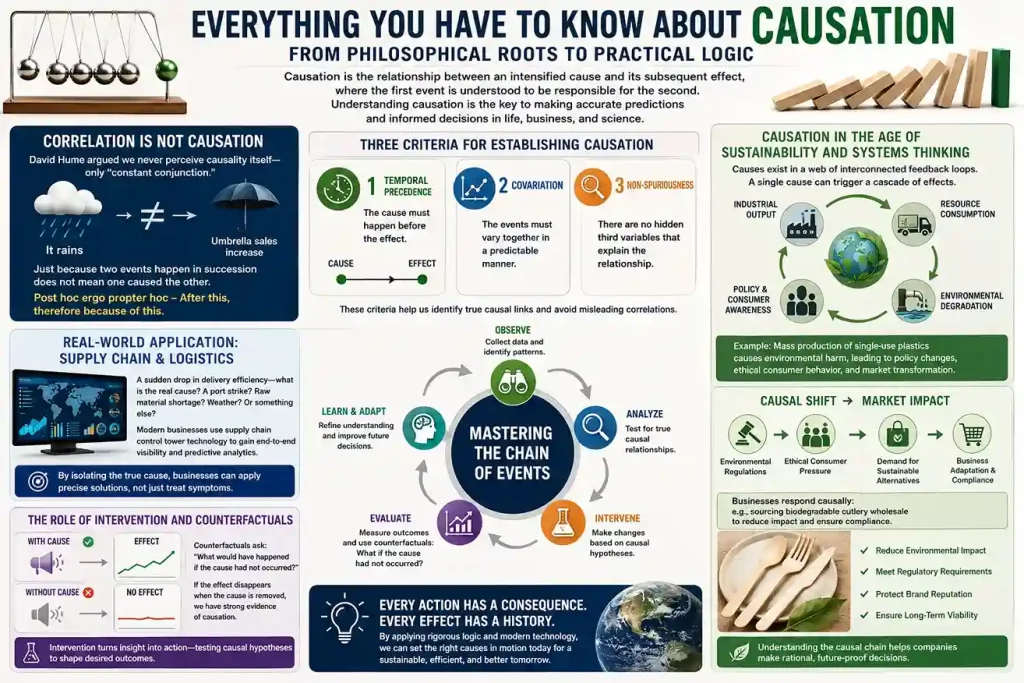
Causation is the fundamental principle that governs our understanding of the universe. At its core, it is the relationship between an intensified cause and its subsequent effect, where the first event is understood to be responsible for the second. While it may seem intuitive, like we push a ball and it rolls, the underlying mechanics of how one event leads to another has been the subject of intense debate among philosophers, physicists, and data scientists for centuries. In the modern world, understanding causation is not merely an academic exercise; it is the vital key to making accurate predictions and formulating informed decisions in both personal life and global commerce.
🧠 Understanding Causation
Causation is the foundation of logical thinking, scientific discovery, and strategic decision-making. Understanding why events happen helps individuals and organizations make smarter choices and predict future outcomes with greater confidence.
🔍 Correlation vs Causation
Just because two events occur together does not mean one causes the other.
⏳ Temporal Precedence
A genuine cause must always occur before its effect.
📊 Systems Thinking
Modern problems involve interconnected causes and feedback loops.
🌱 Sustainability
Understanding environmental cause-and-effect drives responsible decisions.
✨ Why Causation Matters
Whether you’re a scientist, entrepreneur, student, or policymaker, identifying true causes helps solve problems, avoid costly mistakes, and create sustainable long-term success.
Correlation is Not Causation
The most critical lesson in mastering the concept of causation is the ability to distinguish it from mere correlation. David Hume, the 18th-century Scottish philosopher, famously argued that we never actually perceive causality itself, we only observe what he termed “constant conjunction.” Just because two events happen in succession, does not inherently mean that one caused another. This logical fallacy, known as “post hoc ergo propter hoc” (after this, therefore because of this), is a trap that many fall into when interpreting raw data or observing social trends.
To establish a true causal link, three rigorous criteria must typically be met in scientific and logical inquiry, including temporal precedence (the cause must happen before the effect), covariation (the events must vary together in a predictable manner), and non-spuriousness (there are no hidden third variables that explain the relationship). In the complex world of modern industry, identifying these links is vital for troubleshooting systemic failures and optimizing performance.
For instance, a global logistics manager might be faced with a sudden drop in delivery efficiency. Was it a regional port strike that caused the delay, or was it a pre-existing shortage of raw materials further up the line? To solve such riddles, firms no longer rely on guesswork. They increasingly turn to digital infrastructure to ask what is supply chain control tower technology, a centralized hub that provides end-to-end visibility and uses predictive analytics to distinguish between coincidental disruptions and true, actionable root causes. By isolating the genuine cause within a sea of correlations, businesses can apply precise solutions rather than wasting resources on symptoms.
Causation in the Age of Sustainability and Systems Thinking
As we progress further into the 21st century, our understanding of causation has shifted toward systems thinking. This approach acknowledges that causes are rarely linear or isolated; instead, they exist within a dense web of interconnected feedback loops. In a system, a single cause can trigger a cascade of effects, some of which may loop back to amplify or dampen the original cause. This is particularly evident in the global movement toward environmental responsibility and the circular economy.
We now possess a profound causal awareness regarding the link between industrial output and environmental degradation. The direct causal relationship between the mass production of single-use plastics and the catastrophic decline in marine biodiversity has triggered a massive shift in global consumer behaviour and governmental procurement policies. This is a classic example of a macro-causal shift which is a change in collective consciousness leading to a change in global market dynamics.
This awareness has created a significant surge in the demand for sustainable alternatives in every sector. For business owners in the hospitality or retail industries, the cause (increasing environmental regulations and ethical consumer pressure) has led to a very specific effect which is the urgent need to source eco-friendly products at scale. Consequently, procurement officers are increasingly seeking out reliable biodegradable cutlery wholesale channels to mitigate their environmental impact and ensure compliance with emerging laws. This shift is not a mere trend but a rational, causal reaction to the reality that continuing with traditional plastics will lead to long-term financial liabilities, brand damage, and ecological insolvency. By understanding the causal chain of environmental impact, companies can pivot their strategies to remain viable in an increasingly green economy.
The Role of Intervention and Counterfactuals
To truly understand causation, one must also understand the concept of counterfactuals, asking “what would have happened if the cause had not occurred?” This is the basis of the modern scientific method and A/B testing in digital marketing. If we remove the cause and the effect disappears, we have strong evidence for a causal relationship.
In business operations, this involves intervention. When a company uses a control tower to intervene in a delayed shipment, they are essentially testing a causal hypothesis: If I reroute this cargo, will the delay be mitigated? This level of interventionist thinking allows leaders to move beyond being passive observers of their business and become active architects of their desired outcomes. It moves the focus from “what happened?” to “how can we make it happen differently next time?”
Mastering the Chain of Events
Mastering the concept of causation allows us to move beyond reactive living and toward proactive, strategic management. Whether you are a scientist conducting a double-blind medical study, a philosopher pondering the nature of free will, or a CEO navigating the complexities of global logistics, the ability to isolate variables and identify true drivers of change is indispensable.
Ultimately, the study of causation reminds us that every action has a consequence, and every effect has a history. In an interconnected world, our actions, whether choosing a specific technology for oversight or selecting sustainable materials for our products, set off ripples that extend far beyond our immediate sight. By applying rigorous logic and leveraging modern technology to oversee these intricate chains of events, we can better navigate the complexities of the modern world, ensuring that the causes we set in motion today result in the positive, sustainable, and efficient effects we desire for tomorrow.