How to Keep Pets and Kids Safe Around Christmas Lights
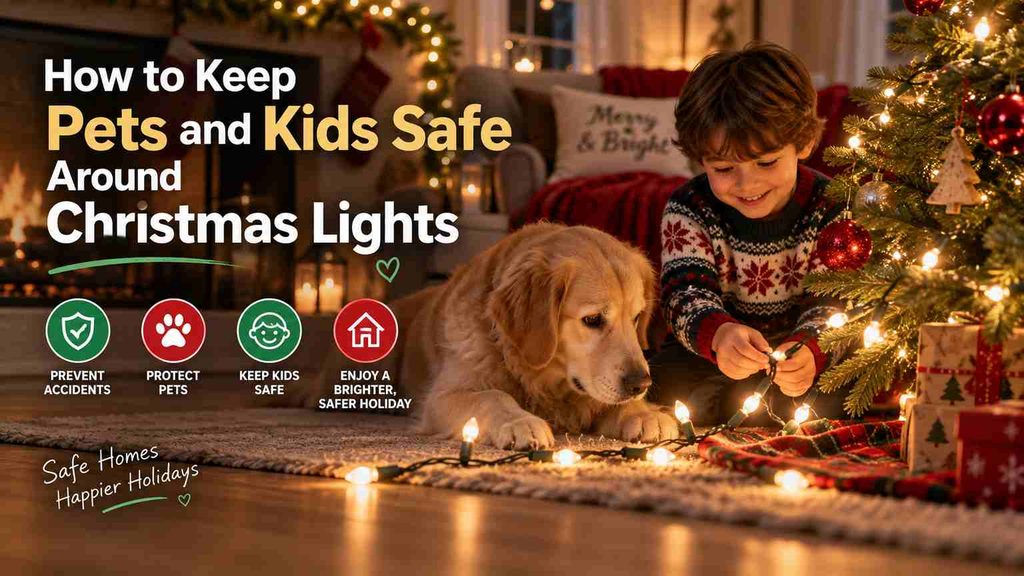
Holiday decorating changes a home fast. Lights go up, ornaments come out, and everything that used to be furniture becomes a climbing obstacle or a chew target. For families with dogs, cats, toddlers, or kids under five, christmas light safety for pets and kids deserves the same attention as picking out the lights themselves. The hazards aren’t abstract. Chewed cords cause arc faults and house fires. Glass bulbs leave fragments where bare feet and paws go. Low-hanging strands become pull-toys for toddlers who haven’t figured out what a socket is yet. Most of it’s preventable. And most of the prevention happens before anything gets plugged in.
1. Tuck and Secure Cords Before Plugging In Any Display
Loose cords on the floor are the first hazard, and usually the biggest one. Dogs chew them. Cats bat at them and then chew them. Toddlers grab them and pull. None of those end well. Thing is, this one doesn’t require any special equipment. Run cords behind furniture wherever possible. Use cord clips or flat cord covers to hold sections against baseboards and out of reach from floor level. For cords that have to cross a walking path, a cord-cover ramp designed for high-traffic floors costs under fifteen dollars at any hardware store and keeps the cord from being something a paw or a small foot catches in the dark.
The connection joints between extension cords and light strands deserve specific attention. Those joints typically sit at floor level and they’re the section most likely to get investigated by a dog or a cat. It’s a textural thing, not random. A strip of electrical tape wrapped around the junction helps, though it’s not a substitute for keeping the whole run elevated or tucked away. Any cord showing visible damage from last season doesn’t come back into service. Frayed insulation and cracked plastic near the socket end are the conditions most likely to cause an arc fault in a home where a pet is spending time on the floor within reach of that cord. Per the ESFI holiday electrical safety guide, damaged cords get replaced, not repaired.
2. Switch to LED Christmas Lights to Cut Heat and Shock Risk
The LED versus incandescent question matters more in a pet and child household than almost anywhere else. Incandescent bulbs run hot. C7 and C9 incandescent Christmas bulbs can heat their glass surfaces to over 120°F after a few hours of continuous use in a dry indoor environment. That’s warm enough to cause a contact burn on a small hand and warm enough to singe fur if a cat decides to sleep at the base of the tree. LED bulbs stay close to room temperature, even after six or eight hours of running.
For indoor trees where the cat is going to end up underneath regardless of what anyone does, that thermal difference matters in a practical way. And honestly, the voltage issue is worth knowing about too. Most incandescent holiday strands run on the full 120V line voltage, present at each bulb socket in the circuit. LED strands step the voltage down through a driver, reducing the individual bulb exposure considerably.
A toddler who gets to a bulb before anyone catches them is in a better situation with an LED strand than with an old incandescent one. The full breakdown on LED bulb types and how they compare thermally and visually is covered in the cool white vs warm white Christmas lights guide, which is worth a read before replacing older strands this season.
3. Keep Christmas Light Strands Above Pet and Toddler Height
Height is the biggest variable most families get wrong. A strand at five feet is functionally invisible to a dog or a toddler standing up. A strand draped across a mantle at eighteen inches is a pull-toy. The lights are identical. The risk is not. For indoor trees, clear the bottom third of the tree entirely. That’s the reach zone for a standing toddler and any dog or cat that isn’t jumping. Non-breakable ornaments can fill that space if you want the visual density, but nothing powered, nothing glass, and nothing with a metal hook should live below knee height. Look, the outdoor situation is a different problem. Extension cords running from the house to the display across a yard where a dog spends unsupervised time need to be elevated on a reel or run under a cord protector. Dogs left alone in a yard with a low-hanging lit strand will investigate it. That’s not a behavioral issue with the dog. That’s a cord-routing decision that wasn’t made before setup.
Outdoor outlets running holiday displays should have weatherproof covers and GFCI protection. If the exterior outlet on your home doesn’t have a built-in GFCI already, use a GFCI outlet adapter (these trip the circuit instantly if moisture or a ground fault is detected) before running anything off it this season.
4. Unplug All Displays Before Leaving a Room or Going to Bed
This is the tip most households skip. The tree looks good when it’s lit. Leaving it on while you’re in the kitchen for twenty minutes seems harmless. Leaving it on overnight feels acceptable because you’ll be up at six anyway. What changes when the room empties? A dog that sits quietly next to the tree while you’re watching a show will walk over and investigate it the moment you leave. Cats are specifically attracted to the vertical structure and the dangling objects. A cat navigating a lit Christmas tree at 2am with no one watching is a genuine fire risk if it dislodges a strand onto a dry section of lower branches.
The Red Cross holiday fire safety guide recommends unplugging all holiday lights before sleep, every night. A smart outlet timer removes the need to remember. Set it to shut off at bedtime and turn back on in the morning. The display is off when no one’s watching, without requiring a nightly habit to form. And that applies to households where pets are home alone during the workday, too. Eight hours of unsupervised access to a plugged-in tree is the same category of risk as overnight. The timer handles both situations the same way.
5. Use Shatterproof Bulbs on Lower Christmas Light Strands and Branches
Glass breaks. That part isn’t complicated. When a child knocks a low ornament onto a wood floor or a dog swipes a branch with its tail, the fragments go wide. A toddler walking barefoot across a hardwood floor picks up glass silently. A dog with soft paws does the same. Neither shows a visible reaction until someone notices later. Because the fix is simple, there’s no reason not to do it. Swap the bottom third of the tree to shatterproof plastic or resin ornaments and bulbs. Shatterproof versions come in the same shapes, finishes, and colors as glass. The visual difference is minimal from any normal viewing distance. The practical difference is that nothing breaks when something gets knocked loose, which will happen at some point during a four-week season in a household with a dog or a child under four.
For light strands specifically, most modern LED Christmas light strands use plastic lens covers rather than glass capsule bulbs, which eliminates that fragment risk entirely compared to older incandescent strands with actual glass bulbs. If vintage incandescent strands with glass bulbs are part of the display, keep them above the bottom third of the tree, well above the reach zone for both pets and toddlers. A mat or runner at the base of the tree, checked every few days, catches fragments before they become a problem. — Here’s the thing: getting christmas light safety for pets and kids right doesn’t mean redesigning the display. Cord management, bulb type, strand height, supervision timing, and glass exposure on lower branches are the five areas that cover most of what actually sends pets and kids to the vet or urgent care during the holiday season. For outdoor displays, the same cord-routing and height principles apply outside, especially for homes with dogs that spend time in the yard without supervision. The professional Christmas lights installation
team at Elevated Seasons handles exterior setups with cord routing that keeps all connections elevated and covered, with GFCI protection built into the outdoor power setup. The cord-on-the-ground problem doesn’t exist with a professionally managed installation. A safe display is mostly a setup problem. Get the setup right the first weekend of December and the rest of the season takes care of itself.