
From Workwear to Everyday Wear: How Practical Clothing Crosses Cultures
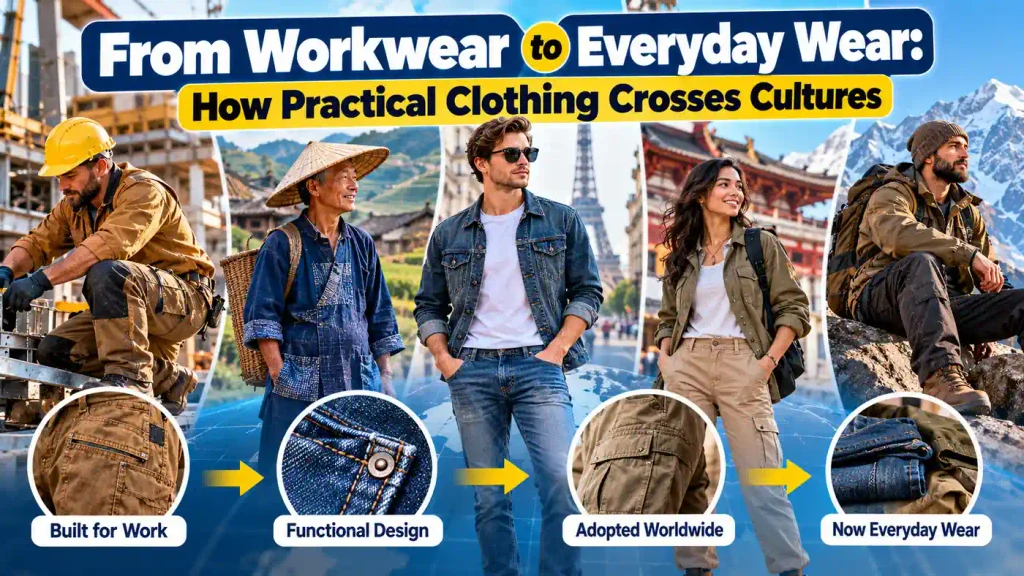
Look at what people wear on an ordinary weekday and you’ll see a quiet history lesson. The sturdy trousers on a commuter, the canvas jacket on a student, the boots on a delivery driver: most of these started as tools. Someone needed clothing that could survive a job, and someone else worked out how to make it.
Culture shapes what we wear, but function often decides what lasts. Clothes that solve real problems tend to spread beyond the people they were made for. They move between trades, countries and generations, picking up new meanings along the way.
This article looks at how practical clothing travels, why some designs stick around for centuries, and what that tells us about how communities borrow from one another.
Work Clothes Have Always Traveled
Nearly every culture has its own tradition of working garments. Japanese farmers and fishermen wore indigo-dyed cotton that could be patched and re-patched, and the stitched repairs eventually became an art form in their own right. Herding communities across Central Asia developed layered, wrapped clothing that handled wide swings in temperature. European tradespeople had smocks, aprons and heavy wool trousers built for their specific crafts.
These garments weren’t designed to be fashionable. They were designed to last. When something is expensive to replace and hard to make, people build it to survive, and they repair it instead of throwing it away.
What makes these traditions interesting is how often they crossed paths. Trade routes carried fabric, dyes and techniques between regions long before anyone talked about global fashion. A weaving method developed in one place showed up in another. A cut that worked for sailors got adopted by dockworkers, then by everyone else.
Denim’s Long Road Around the World
Few garments show this movement better than denim. The fabric’s name is commonly traced to the French city of Nîmes, and the word “jean” is often linked to Genoa, where a similar sturdy cotton twill was produced. Even the terminology carries a trace of travel.
The word “dungarees” is often connected to a village near Mumbai, where coarse cotton cloth was made and worn by laborers. Sailors, miners, farmers and railway workers in different parts of the world all relied on tough cotton twill because it did one thing well: it didn’t fall apart.
In the nineteenth century, a tailor named Jacob Davis and a merchant named Levi Strauss patented the idea of adding metal rivets to stress points on work trousers. That small change made the pants far more durable, and it’s one of the best-known examples of a practical fix becoming a lasting design.
From there, denim kept moving. It became the everyday fabric of ranch hands and factory workers, then a symbol of youth and rebellion in the twentieth century. Later it turned up in almost every country, worn by people who had never touched a plow or a mine shaft. The garment changed meaning many times, but the fabric and its basic logic stayed the same.
The Design Logic Behind Utility Clothing
Practical clothing tends to follow a few simple rules, no matter where it comes from.
- Reinforce the weak spots. Knees, seams, pockets and seats take the most stress. Extra stitching, patches or double layers extend a garment’s life.
- Give the body room to move. Gussets, pleats and looser cuts let people bend, crouch, climb and carry things.
- Put storage where the hands are. Pockets exist because people need their tools within reach.
- Choose fabric for the environment. Heavy cotton for abrasion, wool for cold, light linen for heat.
None of this is fashionable in itself. But when a garment gets these things right, people notice, and they start wearing it for reasons that have nothing to do with the original job.
How Uniforms and Job Gear Shape Everyday Style
Some of our most familiar clothing began as part of a uniform. Cargo-style trousers with large side pockets grew out of military needs, where soldiers had to carry maps, tools and supplies. Trench coats, peacoats and bomber jackets all came from the same place: clothing built for demanding conditions that later moved into ordinary wardrobes.
The pattern repeats. A design proves itself in a demanding setting, civilians pick it up because it’s comfortable and durable, and the style gets absorbed into everyday life. Often the original purpose fades from memory. Few people wearing a peacoat think about naval crews on cold decks.
This borrowing isn’t a modern habit. It has happened as long as people have had clothes. What has changed is the speed. Today a garment designed for one profession can reach an audience on the other side of the world within a season.
Where Modern Hybrids Fit In
The most recent chapter in this story is the blend of workwear and everyday casual clothing. People want pants that look normal in a coffee shop but can handle a long day of moving around, carrying things and working on their feet. That’s why styles like tactical jeans have found buyers well beyond the professions they were designed for. They look like ordinary denim, but the reinforced stitching and flexible fabric come straight from duty clothing.
It’s the same old process at work. A design built for a specific job gets adapted, softened and passed along to a wider group of people who value the same qualities.
Why Durability Still Matters
For a long time, clothing was expected to last years. Then cheap, fast-turnover fashion changed that expectation, and plenty of people now own garments that wear out after a handful of washes.
There’s a growing pushback. Many shoppers have started asking a simple question again: will this hold up? That question connects modern buyers with the tailors, farmers and tradespeople who came before them.
A few things are worth checking before buying any pair of durable pants:
- Stitching. Look at the seams, especially around pockets and the crotch. Tight, even stitching usually signals better construction.
- Fabric weight and weave. Heavier fabric resists abrasion, but a little stretch adds comfort for active days.
- Hardware. Zippers, buttons and rivets should feel solid, not flimsy.
- Fit through the hips and knees. If you can’t squat comfortably in the fitting room, you probably won’t enjoy wearing them.
- Care instructions. Clothing that’s easy to wash and dry gets worn more often, and that matters for long-term value.
What Clothing Says About Communities
There’s something worth remembering when we talk about clothing that crosses cultures. Borrowing isn’t always neutral. Some garments carry deep meaning for the communities that made them, tied to religion, identity, history or craft. Wearing them without understanding that context can feel careless, or worse.
Practical clothing sits in a different place. A rivet, a pocket or a reinforced knee belongs to no single group. Those ideas spread because they solve problems everyone shares. Still, it’s worth knowing where a style came from and giving credit to the people who developed it.
Curiosity helps here. Ask where a fabric was first made, who wore a cut before it became popular, and what the original job required. The answers are usually more interesting than the marketing.
A Few Patterns Worth Noticing
Looking across all of these examples, some patterns show up again and again.
Clothing spreads along the same paths as people, goods and ideas. Migration, trade, war and work have always carried garments from one place to another.
Function comes first, style follows. Most of the pieces we now consider classics started as plain solutions to physical problems.
Meaning changes as clothing moves. Denim meant hard labor in one era and youthful rebellion in another. A jacket built for sailors became a fashion statement. The same object can carry many stories.
Practical design lasts. Trends come and go, but reinforced seams and well-placed pockets never really go out of date.
Conclusion
The clothes we wear every day carry a lot more history than most of us realize. Work trousers, sturdy jackets and utility pockets are the result of generations of trial and error, shared between trades and continents.
The next time you pick out a pair of pants or a jacket, think about the problem it was built to solve. That small habit makes it easier to spot quality, avoid disposable buying and appreciate the people who figured it out first.
Durable clothing usually comes from designs tested in real working conditions, and good construction shows up in the seams, the fabric weight and the hardware. Hybrids that blend workwear with casual style continue an old pattern rather than break from it. Learning where a style comes from adds meaning and helps you credit the cultures behind it.
Practical clothing has always crossed borders. It probably always will, as long as people need something that works and want it to look good too.