
What Is a Nationality Checking Service? How It Works
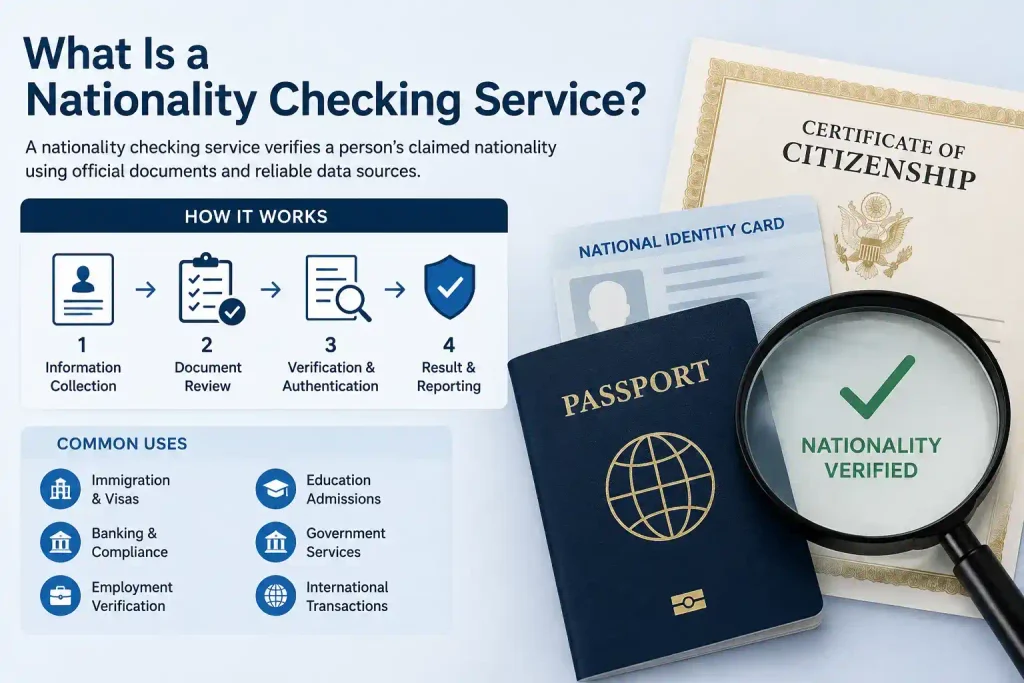
A nationality checking service helps verify a person’s nationality using reliable documents, official records, and identity information. Organizations may use these checks when they need to confirm where a person legally belongs or which country recognizes them as a national.
Nationality verification can be important for employment, immigration, banking, visa applications, compliance checks, and government procedures.
The process usually involves reviewing documents such as a passport, national identity card, birth certificate, citizenship certificate, or other official evidence. The exact requirements depend on the country and the organization requesting the check.
What Is a Nationality Checking Service?
A nationality checking service is a process used to verify a person’s claimed nationality.
In simple terms, the service checks whether the documents and information provided by an individual support their nationality claim.
For example, a person may state that they are a national of Pakistan, the United Kingdom, Canada, or another country. A nationality verification process may review relevant documents to confirm that claim.
Depending on the purpose of the check, the process may include:
- Reviewing identity documents
- Checking passport information
- Verifying citizenship documents
- Comparing personal details
- Reviewing official nationality records
- Checking document authenticity
- Confirming eligibility for a specific service
A nationality check does not always involve the same process. An employer may require different evidence than an immigration authority or financial institution.
What Does Nationality Mean?
Nationality is the legal relationship between a person and a country or state.
A person’s nationality usually determines the country with which they have a recognized legal connection.
For example, a person may be a Pakistani national, a British national, or a Canadian national.
Nationality can affect several legal matters, including:
- Passport eligibility
- Immigration rights
- Visa requirements
- Right to enter or remain in a country
- Access to consular assistance
- Employment eligibility in certain countries
- Legal rights under national laws
The exact meaning of nationality can vary between legal systems. Some countries also use different categories of nationality or citizenship.
Nationality vs Citizenship
Nationality and citizenship are often used as if they mean exactly the same thing. However, the terms can have different legal meanings.
Nationality generally describes a person’s legal connection with a state.
Citizenship often refers to the legal rights and duties associated with full membership in that state.
In many countries, a person who is a national is also a citizen. However, this is not always the case.
A nationality checking service may therefore need to identify the exact legal status of an individual rather than simply relying on how the person describes themselves.
Nationality vs Ethnicity
Nationality and ethnicity are different.
Nationality is a legal or political relationship with a country.
Ethnicity relates to cultural, ancestral, linguistic, or historical background.
For example, a person may legally hold British nationality while having Pakistani, Punjabi, Indian, African, Arab, or another ethnic background.
A nationality check focuses on legal nationality. It does not determine ethnicity.
This distinction is important because ethnicity cannot be reliably established through nationality documents.
Nationality vs Country of Birth
A person’s country of birth is also not always the same as their nationality.
For example, someone may be born in one country and later become a national or citizen of another country.
A person could:
- Be born in Pakistan
- Later move to Canada
- Become a Canadian citizen
- Hold Canadian nationality
Another person may be born in a country without automatically receiving that country’s nationality.
Because of these differences, a nationality verification process should not rely only on the place of birth.
How Does a Nationality Checking Service Work?
The process can vary depending on the organization. However, most nationality checks follow several common stages.
Step 1: Collecting Personal Information
The organization first collects basic identifying information.
This may include:
- Full legal name
- Date of birth
- Place of birth
- Current address
- Previous names
- Declared nationality
The information is then compared with supporting documents.
Step 2: Reviewing Identity Documents
The next stage usually involves reviewing official identity documents.
A passport is one of the most common documents used during nationality verification.
Other documents may also be relevant, depending on the person’s circumstances.
The reviewer checks whether the document contains consistent and valid information.
Step 3: Checking Nationality Evidence
The organization then reviews documents that support the nationality claim.
These may include a:
- Passport
- National identity card
- Certificate of citizenship
- Certificate of naturalization
- Registration certificate
- Official government record
The type of evidence required depends on the relevant country’s laws and the reason for the check.
Step 4: Verifying Document Information
The information provided in different documents is compared.
The reviewer may check whether the following details match:
- Name
- Date of birth
- Nationality
- Photograph
- Document number
- Expiry date
- Place of issue
Any differences may require further investigation.
Step 5: Checking Document Authenticity
Modern verification services may use technology to examine identity documents.
This can involve checks for:
- Security features
- Altered information
- Inconsistent document details
- Expired documents
- Suspected fraud
Some organizations may also compare information with approved databases or official verification systems where legally permitted.
Step 6: Completing the Verification
Once the required evidence has been reviewed, the organization determines whether the information meets its verification requirements.
The result may be:
- Verified
- Verified with additional information
- Pending further review
- Unable to verify
A successful check does not necessarily mean that every possible legal question about nationality has been resolved. It only means the available evidence satisfied the requirements of that particular process.
What Documents Are Used to Verify Nationality?
The documents required for nationality checking depend on the country and the purpose of verification.
Common documents include the following.
Passport
A valid passport is often the strongest form of evidence for nationality.
A passport normally identifies:
- The passport holder
- Their nationality
- Date of birth
- Place of birth
- Passport number
- Issuing authority
However, the exact legal significance of a passport depends on the issuing country.
National Identity Card
Many countries issue national identity cards.
These cards may include nationality information or provide evidence of the person’s legal identity.
Some countries do not have a national identity card system.
Citizenship Certificate
A citizenship certificate may be used as evidence that a person has acquired citizenship.
This can be important when the person became a citizen after birth.
Naturalization Certificate
A naturalization certificate may provide evidence that an individual legally acquired nationality or citizenship through naturalization.
The requirements for naturalization vary by country.
Birth Certificate
A birth certificate may provide useful information, including the person’s place of birth and parentage.
However, a birth certificate does not always prove current nationality.
This is because nationality laws differ between countries.
Other Official Records
Additional evidence may sometimes be required.
This could include:
- Registration records
- Immigration documents
- Government-issued certificates
- Official letters from relevant authorities
Who Uses Nationality Checking Services?
Nationality verification is used by many different organizations.
Government Departments
Government agencies may need to verify nationality when processing applications or providing certain services.
This may involve:
- Passports
- Immigration applications
- Citizenship matters
- Consular services
- Legal documentation
Employers
Some employers need to verify whether an individual has the legal right to work in a particular country.
This process may involve checking nationality, immigration status, or work authorization.
An employer should not assume that nationality alone determines a person’s right to work.
The legal requirements depend on the country.
Immigration Authorities
Immigration systems often require nationality information to process applications.
Nationality can affect:
- Visa requirements
- Entry rules
- Travel permissions
- Residence applications
- Deportation procedures
Immigration authorities may use official systems to verify nationality claims.
Banks and Financial Institutions
Financial institutions may need nationality information for regulatory and compliance purposes.
This can be relevant to:
- Know Your Customer procedures
- Tax reporting
- International compliance
- Identity verification
Banks usually follow specific legal and regulatory requirements.
Educational Institutions
Universities and colleges may need to verify nationality for:
- International student applications
- Tuition categories
- Scholarship eligibility
- Visa sponsorship
Students may be asked to provide a passport or other official evidence.
Why Is Nationality Verification Important?
A nationality checking service can help organizations make decisions using reliable information.
It may reduce the risk of:
- Identity fraud
- Document fraud
- Incorrect records
- False declarations
- Regulatory problems
Nationality verification may also help ensure that the correct rules are applied to an individual.
For example, travel requirements can differ based on nationality. An international bank may also need accurate nationality information for legal compliance.
Nationality Checking for Employment
Employment checks can be complex.
An employer may need to confirm whether an applicant has the legal right to work in the relevant country.
However, nationality and work eligibility are not always the same thing.
For example, a person may not hold the nationality of a country but may still have legal permission to work there.
An employment verification process may therefore review:
- Nationality
- Citizenship
- Immigration status
- Visa status
- Residence status
- Work authorization
The exact legal process depends on local employment and immigration laws.
Nationality Checking for Immigration and Visas
Nationality is often a major factor in immigration applications.
A person’s nationality may affect:
- Whether they need a visa
- The type of visa available
- Entry conditions
- Application procedures
- Required documents
A nationality check helps immigration authorities confirm that the applicant’s legal status is correctly identified.
Applicants should provide genuine and current documents.
Providing incorrect nationality information can create serious legal and immigration problems.
Nationality Checks for Banks and Financial Institutions
Banks and financial institutions may request nationality information when opening an account or completing compliance procedures.
The purpose can include:
- Confirming identity
- Meeting regulatory obligations
- Tax reporting
- Managing international compliance requirements
Customers may need to provide documents such as:
- Passport
- National identity card
- Residence permit
- Tax identification information
The specific requirements depend on the country and financial institution.
Can Someone Have More Than One Nationality?
Yes. Some people legally hold more than one nationality.
This is often called:
- Dual nationality
- Dual citizenship
- Multiple nationality
For example, a person may legally hold the nationality of both Pakistan and another country, depending on the laws involved.
A nationality checking service may therefore need to record more than one nationality.
An individual should not assume that every country permits dual nationality in every situation. National laws can differ.
How Long Does a Nationality Check Take?
The processing time depends on the purpose of the check.
A simple document review may be completed quickly.
A more complex case may take longer if it involves:
- Multiple documents
- Foreign documents
- Translation requirements
- Inconsistent information
- Additional government verification
An organization should provide its own expected processing timeline.
Common Problems During a Nationality Check
Several issues can delay verification.
Expired Documents
An expired passport or identity document may not satisfy the organization’s requirements.
Different Names
A person may have documents showing different names due to:
- Marriage
- Divorce
- Name changes
- Spelling differences
Supporting evidence may be required.
Incorrect Information
Small differences in dates or spelling can create verification problems.
For example, a person’s name may be spelled differently across documents.
Missing Documents
A person may not have the primary document requested by the organization.
Alternative evidence may sometimes be accepted.
Foreign Language Documents
Documents may need to be translated before they can be reviewed.
The organization may require a certified translation.
Dual or Multiple Nationalities
A person with more than one nationality may need to provide additional information about their legal status.
How to Prepare for a Nationality Verification
You can make the process easier by preparing your documents before submitting them.
Use Current Documents
Check that your passport or identification document has not expired.
Check Your Personal Details
Make sure your name, date of birth, and other information are accurate.
Explain Name Differences
Provide supporting documents if your name has changed.
Submit Clear Copies
If the organization accepts digital copies, make sure all information is readable.
Avoid blurry or incomplete images.
Provide Additional Evidence When Requested
Do not ignore requests for further documents.
Additional evidence may help resolve inconsistencies.
Nationality Checking vs Identity Verification
These terms are related but different.
Identity verification confirms that a person is who they claim to be.
Nationality verification focuses on confirming the person’s legal nationality.
A passport can sometimes help establish both identity and nationality.
However, a nationality check may require more specific evidence in complex situations.
Nationality Checking vs Citizenship Verification
Citizenship verification focuses specifically on confirming citizenship status.
Nationality verification can be broader because legal systems may distinguish between nationality and citizenship.
The correct type of check depends on the purpose.
For a legal or government application, the exact terminology used by the relevant authority is important.
Nationality Checking vs Background Checks
A background check may review information such as:
- Employment history
- Education
- Criminal records
- Financial information
A nationality check focuses specifically on nationality and related legal status.
The two processes are separate, although an organization may conduct both.
Is Nationality Information Private?
Nationality information is personal information.
Organizations that collect it should handle it according to applicable privacy and data protection laws.
The information should only be collected when there is a valid reason to do so.
People should also be careful when sharing sensitive documents online.
A passport and national identity card can contain valuable personal information.
Before submitting documents, make sure you are dealing with a legitimate organization or official service.
Can a Nationality Checking Service Confirm Everything?
No.
The scope of a nationality check depends on the service being used.
Some checks may only review the documents provided.
Others may involve additional verification methods.
A successful result usually means that the available evidence met the requirements of that particular check. It may not replace an official legal determination by a government authority.
Complex cases involving disputed nationality, citizenship rights, or statelessness may require advice from a qualified immigration lawyer or the relevant government authority.
How to Choose a Nationality Checking Service
If you need a third-party nationality verification provider, consider several factors.
Legal Compliance
The provider should follow relevant privacy and data protection requirements.
Security
Sensitive documents should be stored and processed securely.
Document Coverage
Check which passports, identity cards, and other documents the service can review.
International Support
International verification may be important if your organization works with people from different countries.
Human Review
Automated systems can be useful, but complex cases may require qualified human review.
Clear Reporting
The service should clearly explain what has been verified and what has not.
What Is the Difference Between Nationality Checking and Right to Work Checking?
A nationality check confirms information about nationality.
A right to work check determines whether a person has legal permission to work in a particular country.
These are not always the same.
A foreign national may have legal permission to work through a:
- Work visa
- Residence permit
- Employment authorization
- Immigration status
For this reason, employers should follow the correct legal process for right to work verification instead of relying only on nationality.
What Happens If Nationality Cannot Be Verified?
If a service cannot verify nationality, it may request additional evidence.
Possible outcomes include:
- Requesting another document
- Asking for a clearer copy
- Requesting official certificates
- Referring the case for manual review
- Directing the person to a government authority
An unsuccessful verification does not automatically mean that the person’s nationality claim is false.
It may simply mean that the available evidence was insufficient for that particular process.
Final Thoughts
A nationality checking service helps organizations verify a person’s claimed nationality using official documents and other relevant evidence.
The process may involve passports, identity cards, citizenship certificates, birth records, and other government-issued documents.
Nationality verification can be important for immigration, employment, banking, education, compliance, and other legal procedures.
However, nationality is not always the same as ethnicity, country of birth, citizenship, immigration status, or work authorization.
The most important step is to use accurate documents and follow the requirements of the organization or authority requesting the check.
For complex nationality or citizenship questions, official government authorities or qualified legal professionals are usually the most reliable source of guidance.