
From Disposable To Timeless: Rethinking Sustainability In Tech Accessories
A phone case used to be an afterthought. Something picked up at checkout, thin plastic wrapped around a device that would be replaced in a year anyway. It served a purpose, then yellowed, cracked, or simply fell out of favor. Into the drawer it went, or worse — into the bin. Multiply that by millions, and the scale of quiet waste becomes impossible to ignore.
Yet something has shifted. Not loudly, not with slogans, but in a more measured way. A growing number of users are rethinking what “protection” should mean. Not just in terms of safeguarding a device, but in how an object behaves over time — how it ages, how it feels in the hand, and how long it remains relevant.
The conversation around sustainability in tech accessories is no longer limited to recycled plastics or biodegradable packaging. It is beginning to include longevity, repairability, and the idea that a well-made object can outlast trends, not contribute to them.
The hidden cost of convenience
Plastic cases are convenient by design. They are inexpensive, easy to produce, and available in endless variations. That accessibility is part of their appeal — and part of the problem.
A mass-produced case is built for uniformity, not for endurance. It serves a short cycle: buy, use, replace. Its material resists change in the worst way, degrading rather than evolving. Scratches do not add character; they diminish it. Over time, the object becomes less appealing, not more.
This pattern has shaped expectations. People have grown used to replacing accessories as often as they upgrade their phones. Durability has been quietly replaced by disposability.
But when sustainability is reduced to recycling alone, something is missing. The most sustainable object is often the one that does not need to be replaced in the first place.
The return of material intelligence
There is a different philosophy emerging — one rooted in materials that respond to time rather than resist it. Full-grain leather sits at the center of that shift.
Unlike synthetic alternatives, full-grain leather retains the natural structure of the hide. It carries subtle variations in texture, tone, and pattern. No two surfaces are identical. These imperfections are not flaws; they are signatures.
Over time, the material develops a patina — a soft sheen shaped by use. Contact with hands, exposure to light, and the rhythm of daily life all leave their mark. Instead of deteriorating, the object becomes more defined, more personal.
Exotic leathers take this even further. Python, for instance, introduces a layered texture that changes in depth and nuance as it ages. It is not static. It reacts, adapts, and records.
This quality changes the relationship between user and object. The case is no longer a temporary shield. It becomes something that evolves alongside the device it protects.
Craftsmanship as a counterpoint
Material alone is not enough. The way it is shaped matters just as much.
Artisan craftsmanship introduces a level of precision and care that industrial production cannot replicate. Each cut, each stitch, each edge is considered. The result is not just functional — it is intentional.
Handcrafted cases are built in smaller batches, often by skilled makers who understand how leather behaves. They account for stretch, tension, and wear. They work with the material, not against it.
This approach leads to subtle differences between pieces. No two cases are exactly alike. That uniqueness is not accidental; it is inherent to the process.
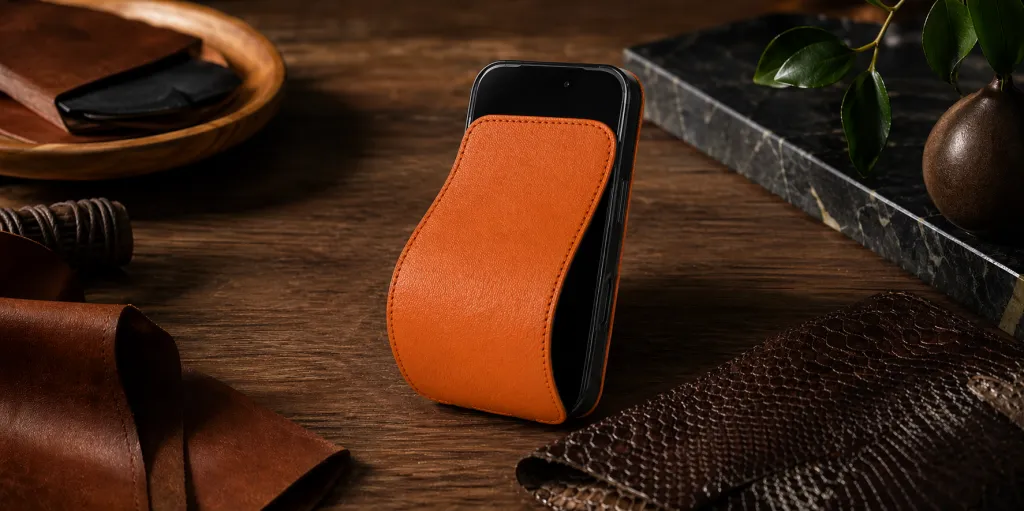
Somewhere in the middle of this conversation, a new category has quietly taken shape — handmade leather iPhone cases with magnetic lid. They represent a shift away from passive protection toward something more dynamic.
Innovation in quiet forms
True innovation does not always announce itself. Sometimes it appears as a small adjustment that changes the entire experience.
Marcel Robert has introduced a concept that fits this description with precision. Their flip case design features a flexible magnetic lid — a detail that, at first glance, seems simple. In practice, it alters how the case interacts with the device.
When closed, the lid rests gently against the screen. With each movement, it performs a subtle function: it helps keep the display clean. No extra cloth, no added step. Just a natural extension of everyday use.
The magnetic mechanism is carefully calibrated. It holds securely without stiffness, allowing the lid to move with ease. The flexibility ensures that the case adapts to handling rather than resisting it.
This is not about adding features for the sake of complexity. It is about refining what already exists, making it more intuitive, more integrated.
Durability as sustainability
Sustainability is often framed in terms of materials and sourcing. Both matter. Yet durability plays an equally significant role.
A leather case that lasts for years reduces the need for replacements. It minimizes waste not through decomposition, but through persistence. It stays relevant, functional, and visually compelling over time.
This challenges the idea that sustainability must always look “eco-friendly” in the conventional sense. A product can be sustainable because it endures, because it avoids becoming waste in the first place.
Mass-produced plastic cases rarely achieve this. They are designed for short-term use, with little consideration for how they will age. Their lifecycle is built into their structure.
Leather, particularly when crafted with care, offers an alternative. It invites continued use. It rewards it.
The emotional dimension of objects
There is also a less tangible aspect to this shift — one that is often overlooked.
Objects that age well tend to stay. They become familiar. They develop a presence that extends beyond function. A leather case that carries the marks of use feels different from one that remains unchanged.
This sense of continuity influences behavior. People are less likely to discard something that has evolved with them. The object holds a form of memory, even if it is subtle.
That connection reduces consumption in a way that no marketing campaign can replicate. It changes habits from within.
Redefining value
Price has long been the primary measure of value in tech accessories. Lower cost meant easier replacement, and replacement became routine.
Premium leather cases challenge that equation. Their value is not defined by immediate affordability, but by long-term relevance.
When a case remains in use for years, its cost spreads across time. The initial investment becomes less significant than the experience it provides throughout its lifespan.
This perspective aligns with a broader shift toward mindful consumption. Buying less, choosing better, and expecting more from each object.
In this context, the handmade leather iPhone cases with magnetic lid takes on a deeper meaning. It is not just a product. It reflects a different approach to design, use, and longevity.
A quieter future for everyday objects
The future of sustainable tech accessories may not be defined by radical materials or dramatic changes. It may look more like refinement — small, thoughtful improvements that accumulate over time.
A case that protects while maintaining the device. A material that improves with age. A design that integrates function without excess.
These elements do not demand attention. They operate in the background, shaping the experience in ways that feel natural rather than imposed.
There is a certain restraint in this approach. A focus on what matters, without unnecessary additions. A recognition that sustainability is not only about what something is made from, but how it lives over time.
Plastic will not disappear overnight. Nor will the habits that support it. Yet alternatives are becoming more visible, more compelling.
The shift from disposable to timeless is not a trend. It is a recalibration. A move toward objects that respect both the user and the resources behind them.
And in that quiet transition, something changes — not just in what we carry, but in how we choose.