How to Light a Hallway Full of Family Photos
Quick Info: Before you buy a new light, move one frame along the wall — if the glare slips off the photo, the spot is the problem, not the fitting. Flush mount lighting suits narrow halls because it sits close to the ceiling, but check whether the shade sends light toward the walls as well as down. Test with your smallest, darkest photo in a borrowed frame with glass before ordering a full matching set.
Table of Contents
Say you have a photograph of six cousins on a back step. Five are looking at the camera. The sixth has a fistful of birthday cake and is watching the dog. That last detail is the reason you picked this particular shot for the hallway. By daylight, anyone walking past can see it. After dinner, from the spot where people actually stop to look, the glass puts a bright white circle right over the kid with the cake.
It’s tempting to blame the ceiling light. Before you go shopping, take the picture off its hook and have someone hold it a little farther along the wall. If the circle slips off the photograph, you may have just fixed the problem. If every frame along that stretch catches the same light, it’s time to look up.
Find the place where people stop
A hallway looks quite different when you’re carrying laundry through it and when you’re showing somebody a picture. For the second job, you need enough room to step back. Put the laundry basket down and try it with your largest frame. Can you take in the whole picture without backing into a door? Is the best view from the living room, looking sideways through the opening? That may be where your favorite photo belongs, even if it throws the spacing off by an inch.
Now try it with the hall light on and the adjoining rooms set up as they would be after dinner. Open the door you usually leave open. Switch off the kitchen if that’s your habit. Walk in from both ends. A reflection that follows you for one step hardly matters. One that sits over a face from the only spot where two people can stand together deserves your attention.
Notice how bright the top of the picture is compared with the wall beside it. Make that comparison in your own hall after dark.
Read the shade as closely as the measurements
Flush mount lighting is useful in a narrow hall because the fixture sits close to the ceiling, leaving the view through to the next room open. That tells you how it fits. How it lights a photograph depends partly on which parts of the shade let light through. In a side view of the fixture, look for the edge of the shade. An opaque metal rim and a milky glass side can look almost identical in a picture taken from directly underneath.
If the metal rim is deep and only the bottom lights up, the runner underfoot may look lovely while the photographs remain hard to read. A shade with a pale, translucent side lets some light travel toward the walls as well. That can help with a shadowy row of frames. It can also give the glass something bright to reflect. Look for a room photo taken with the light switched on. What can you see on the wall beside it? A product close-up can’t answer that question.
There’s also the view from the far end of the hall. Hold a paper circle cut to the fixture’s listed diameter flat against the ceiling, or have someone hold it while you stand in the doorway. You might like a dark outline that picks up the black in a row of frames. Or you may discover that your eye goes straight to the ceiling and stays there. Either reaction is useful before you order.
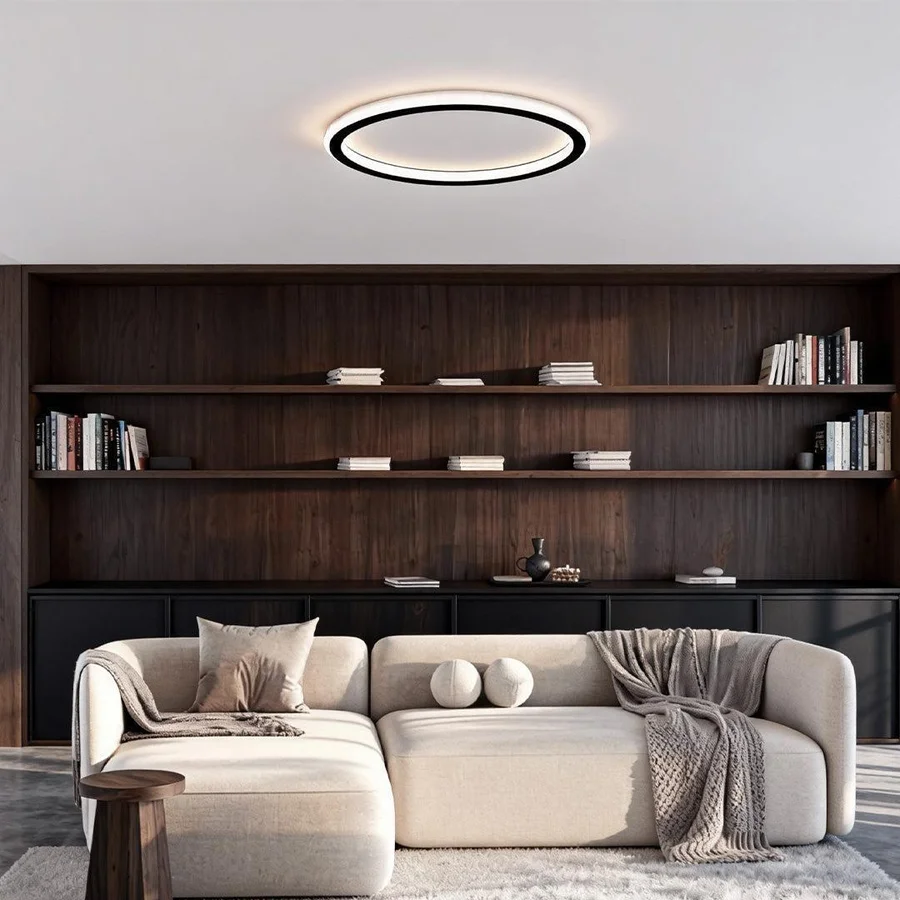
Seen from across the room, even a slim black rim draws a distinct circle on a white ceiling.
Move one frame before you move the whole row
Use the smallest, darkest photograph as your test piece. A white shirt in a sunny garden is usually easy to pick out. Two people in dark coats outside a station are another matter. Have someone hold that frame at a few spots while you watch from the doorway. Then trade places. Someone a head shorter than you may see the lamp reflected where you see a perfectly clear face. Choose the spot that works reasonably well for both of you and mark it with a scrap of painter’s tape.
If you’re planning a new display, borrow a frame with glass for this part. Paper templates will tell you whether the arrangement fits above the bench, but they won’t show you a reflection. Slip an ordinary print into the borrowed frame and test one position before you buy eight matching frames. In a rented hall with a ceiling light you can’t change, this little rehearsal is especially useful.
Leave room for the story
Once the faces are visible, give the captions an evening test of their own. Write one on an index card in the size you plan to use. Can someone read it from a comfortable standing position? A name, a place and a few words that only your family would know are plenty. “Back step, June 1998. The dog got the cake” gives a visitor a reason to look again. If the date is a guess, write “about 1998” and let the next family visit settle the matter.
Keep the pencil handy that first evening. Somebody may remember the dog’s name. If they can point out the guilty cousin without taking the picture off the wall and carrying it into the kitchen, the hall light has done its job.